6 Rhyme Schemes for Rap: Tool Assisted Practice for Lyricists
A rhyme scheme is the pattern of end sounds across a set of bars, mapped with letters like A and B to show which lines rhyme with each other. Pick one pattern, such as AABB, and rap it aloud before you add a single internal rhyme to your strongest word each bar. Researchers like Adams have shown that where you place a rhyme changes how a bar feels, and stacking multisyllabic rhyme on top of a basic scheme is what separates a serviceable verse from one that grips. A tool like Ilena can help you spot those patterns as you draft.
TL;DR:
- Utilizing a consistent rhyme scheme like AABB or ABAB helps build listener expectation and makes hooks more memorable, especially with simple four-line patterns.
- Incorporating internal, multisyllabic, and slant rhymes enriches texture and flow, but placement of these rhymes significantly impacts the verse's rhythm and emotional tone.
- Deliberately placing the strongest rhyme on or near the fourth beat emphasizes authority, while breaking line continuity with internal rhymes creates urgency and tension.
- Layering internal and multisyllabic rhymes in a step-by-step, performance-tested process leads to more fluent and engaging verses.
- Tools like Ilena assist in visualizing rhyme patterns, verifying stress placement, and refining internal and multisyllabic rhymes, but creative control remains with the writer.
Table of Contents
- What Is a Rhyme Scheme, and How Does the Notation Work?
- What Are the Most Common Rap Rhyme Schemes?
- What Types of Rhymes Do Rappers Actually Use?
- How Does Rhyme Placement Change the Way a Verse Feels?
- How Do You Build a Layered Rhyme Scheme Step by Step?
- What Advanced Techniques Push a Verse Further?
- What Drills Actually Build Rhyme Scheme Skill?
- How Ilena Helps You See and Practice Rhyme Schemes
- Practice Your Rhyme Schemes With Ilena
- Sources
- FAQ
What Is a Rhyme Scheme, and How Does the Notation Work?
Every rhyme scheme uses letters to track which line endings rhyme with which. If line one ends in "grind" and line two ends in "time," both get labeled A. A line that breaks the pattern, rhyming with nothing around it, gets marked X. This notation isn't academic decoration. It's a blueprint you can sketch before you write a single bar, so you know exactly where the rhyme needs to land and where you have freedom to breathe.
Rap rhyme patterns matter because they build expectation, the same way a drum pattern does. A listener's ear locks onto a scheme within two or three bars, and everything after that either satisfies the pattern or deliberately subverts it. That tension, between what the ear expects and what the bar delivers, is a big part of what makes a verse compelling instead of just competent.
Here's how the mapping works in practice:
- AABB: "I have been grinding since the door was shut (A) / Now I'm counting up the change and up the cut (A) / They said I wouldn't make it out the block (B) / Now I'm standing on the rooftop with the lock (B)"
- ABAB: "Started in the basement with a busted mic (A) / Every single bar was building up the fight (B) / Now they know my name and know I got the light (A) / Cause I never once let go, I kept it tight (B)"
Notice that scheme alone tells you nothing about quality. A flat AABB with no internal texture will sound thin next to an ABAB loaded with assonance and consonant echoes. The letters are the skeleton. Everything else in this guide is the muscle.
What Are the Most Common Rap Rhyme Schemes?
The most reliable starting point for any rap rhyme scheme is a four-line pattern, and the catalog of common schemes that songwriters have used for decades transfers into rap with a few adjustments for cadence and delivery. Here are the patterns worth learning first, in order of how often you'll actually use them.
- AABB. Two rhyming pairs, back to back. "Rolling through the city with my head up high (A) / Never had to ask nobody why (A) / Every single door they closed, I found a key (B) / That's the kind of hunger that they can't see (B)." This scheme is the workhorse of hooks because the repetition locks in fast.
- ABAB. Alternating rhymes that weave the two sounds together. This pattern rewards patience since the listener has to wait a full extra line before the rhyme resolves, which builds a little suspense inside four bars.
- AAAA. Every line rhymes with every other line. "Never folded, never bent, never broke, never bowed / Kept my head up through the storm, kept my voice loud / Every enemy that came, I stood proud / Turned the doubt into the fuel, turned it around." Four straight hits like this create momentum, but they demand vocabulary range so the rhyme word never feels repeated.
- ABBA. The outer lines rhyme with each other, and the inner two rhyme with each other, forming a kind of rhyme sandwich. This works well when you want to open and close a thought with a punch while burying a supporting detail in the middle.
- AXAA or AAXA. One line in the middle breaks free of the rhyme entirely, which is the X. This is a deliberate release valve. It signals a shift in thought or tone before snapping back to the pattern.
- AXXA. The two middle lines float independently of the outer rhyme, letting you insert a quick aside or a punchline setup between two connected bookends.
For six-line stanzas, many rappers stretch AABB into AABBCC, or nest an ABAB core inside a longer verse with a couplet tag at the end. Hooks tend to favor tight, predictable schemes like AABB because they need to be memorable on first listen. Verses tolerate more complexity, since the listener has already bought in and wants to be surprised. Punchline bars often lean on AAAA or a tight AABB, because a rapid string of matching sounds gives a punchline momentum right up to the payoff word.
What Types of Rhymes Do Rappers Actually Use?
Rap rhyme schemes are only the frame. What fills that frame is a mix of rhyme types, and knowing all four gives you far more control than relying on end rhyme alone.
End rhyme is the baseline: the last stressed syllable of each line matching the scheme you chose. It's necessary, but on its own it can sound mechanical, like a nursery rhyme wearing a hoodie.
Internal rhyme happens inside a single bar, or reaches across to a word in the next bar rather than sitting only at the line's end. Internal rhymes function as rhythmic anchor points that keep the ear engaged between the end rhymes, and they come in a few flavors:
- Same-line internal rhyme: two words within one bar that echo each other.
- Cross-line internal rhyme: a word mid-bar that rhymes with a word mid-bar in the next line, invisible on the page but audible on delivery.
- Stacked internal rhyme: three or more rhyming sounds packed into consecutive syllables, which is where flow starts to feel virtuosic.
Multisyllabic rhymes extend a rhyme across two or three syllables instead of one, so "gravity" can pair with "have it, we" if the stress and vowel sounds line up closely enough. Spotting these requires listening past spelling, since phonetic analysis of rap lyrics shows rappers frequently exploit pronunciation shifts that a written page would never reveal.
Slant rhymes, along with alliteration and consonance, round out the toolkit. A slant rhyme pairs sounds that are close but not exact, like "strong" and "long" versus the looser "strong" and "wrong." Alliteration repeats a starting consonant across words; consonance repeats a consonant sound anywhere in the word. None of these need to carry a whole scheme, but they thicken texture between the rhymes that do.
How Does Rhyme Placement Change the Way a Verse Feels?
Where a rhyme lands inside the bar matters as much as whether it lands at all. Academic analysis of rap flow treats rhyme as a rhythmic layer separate from the beat itself, one that interacts with meter rather than simply riding on top of it. Placing a rhymed syllable on or near the fourth beat of a bar is one of the most common ways rappers mark the end of a musical measure, giving the listener a clean signal that one thought has closed and another is about to open.
But that clarity is optional, not mandatory. Dense internal rhyme or a well-placed enjambment, where a sentence's grammar spills past the bar's end instead of stopping there, can blur that fourth-beat marker on purpose. The effect is a verse that feels like it's running ahead of the beat, or dragging just behind it, creating friction that a metronomic scheme never produces.
This is where rhyme scheme stops being a static grid and starts being a performance tool. If you want a bar to land with authority, put your strongest rhyme, ideally a multisyllabic one, right on that fourth beat. If you want a verse to feel restless or urgent, break the line early with an internal rhyme and let the sentence spill into the next bar before the end rhyme resolves.
Enjambment is the clearest example of this trade-off. A scheme printed on the page might read as clean ABAB, but if the second line's grammar doesn't complete until three words into the third line, the ear hears something closer to a single flowing thought interrupted by rhyme, not four separate statements. Scholarship on rhyme's role in rap treats this structural function as central, not decorative: rhyme placement shapes how a listener segments the verse into units of meaning, which is a bigger job than most beginning writers give it credit for.
The practical guidance here is simple to state and hard to master: decide, bar by bar, whether you want the rhyme to support the meter or push against it. Both choices are legitimate. The mistake is doing it by accident.

How Do You Build a Layered Rhyme Scheme Step by Step?
Layering is how a verse goes from readable to replayable, and it happens in a fixed order that resists shortcuts.
Step 1: Choose an end-rhyme skeleton and map it to beats. Pick AABB, ABAB, or one of the six-line variants, then write out your bar count and mark exactly where each end rhyme needs to fall. Don't write a single full sentence yet. Just plant the rhyme words at the ends of each line.

Step 2: Choose a core vowel or consonant sound to seed your internal rhymes. This is the technique advanced writers used to keep a verse cohesive without forcing every single word to rhyme. Pick one dominant vowel sound, an "ah" or an "ee," and scatter it through the middle of your bars at staggered, syncopated positions rather than in a predictable row.
Step 3: Add multisyllabic rhymes and stagger them across bars. Once your skeleton and internal seed sound are in place, look for two or three syllable clusters that can echo each other across consecutive lines. Stagger the onset and release of each multisyllabic pair so the rhyme lands across bars rather than bunching in one spot, which keeps the line from sounding overstuffed.
Step 4: Rap it aloud and tighten for clarity. This step is non-negotiable. A scheme that reads well on paper can trip over itself in performance if syllable stresses don't line up with the beat. Cut any word that exists only to serve the rhyme and adds nothing to meaning.
Pro Tip: Record a rough take of your verse on your phone before you consider it finished. Listening back reveals clunky syllable stacks and dead rhymes that your eyes will skip right over on the page.
What Advanced Techniques Push a Verse Further?
Once the basics are solid, a few higher-level moves separate a technically correct verse from one with real character.
Enjambment lets a sentence's meaning run past the bar break, which resists the temptation to make every line a complete, predictable thought. It's one of the fastest ways to make a scheme feel less like a worksheet.
Syncopated rhyme placement, where you deliberately put a rhymed syllable slightly off the beat instead of squarely on it, creates a kind of secondary percussion. Treat the rhymed syllables themselves as a rhythm track you can move around independent of the drum pattern underneath. That's a technique advanced rappers lean on constantly to make dense, technical bars sound musical instead of crowded.
Flip-flop schemes, where you switch from AABB to ABAB mid-verse, or drop a scheme entirely for a few bars of freeform internal rhyme, work best when the switch tracks a shift in the verse's subject matter or emotional register. A clean landing back into the original pattern signals control rather than confusion.
The guiding rule across all of these techniques: complexity only earns its place if intelligibility survives it. A dazzling internal-rhyme cascade that no listener can parse on a first listen has failed at its actual job.
What Drills Actually Build Rhyme Scheme Skill?
Reading about technique only gets you so far. These drills, drawn from common songwriting practice guidance, build the muscle directly.
- Convert a scheme. Take any AABB stanza you've already written and rewrite it as ABAB, keeping the same subject matter. Note exactly how the rhythmic feel shifts once the rhyme resolution stretches across two extra lines.
- Seed one vowel sound. Choose a single vowel sound and thread it through three separate spots in one bar without forcing the sentence to sound unnatural.
- Stack multisyllables across four bars. Pick a two-syllable rhyme pair and stagger its parts, one syllable landing in bar one, its partner in bar three, so the ear has to work slightly to connect them.
- Record and check. Play back every drill and ask three questions: Is every word still doing narrative work? Does the stress land on the beat where you intended? Would a stranger understand this on one listen?
Work on one technique at a time. Layering internal rhyme and multisyllabic density simultaneously, before either is comfortable on its own, is the most common way a verse ends up sounding forced instead of fluent.
How Ilena Helps You See and Practice Rhyme Schemes
Spotting a multisyllabic rhyme buried three words deep in a bar is hard to do by ear alone, especially in your own writing. Ilena's rhyming dictionary surfaces internal and multisyllabic matches as you type, and its rhyme visualization makes the color-coded rhyme families across your bars visible at a glance, the same affordance researchers building computational rhyme models rely on to detect patterns a plain read-through misses.
A practical workflow looks like this: map your scheme, draft your internal rhymes, then run a syllable check to confirm your stresses land where you intended. Ilena assists at each stage, but the pattern you choose, the words you pick, and the final call on every bar stay yours. The tool surfaces options. You remain the author.
Practice Your Rhyme Schemes With Ilena
Once you know how AABB differs from ABAB, and how a multisyllabic rhyme sits differently than a slant rhyme, the real work is building that vocabulary into your own bars without losing your voice in the process.
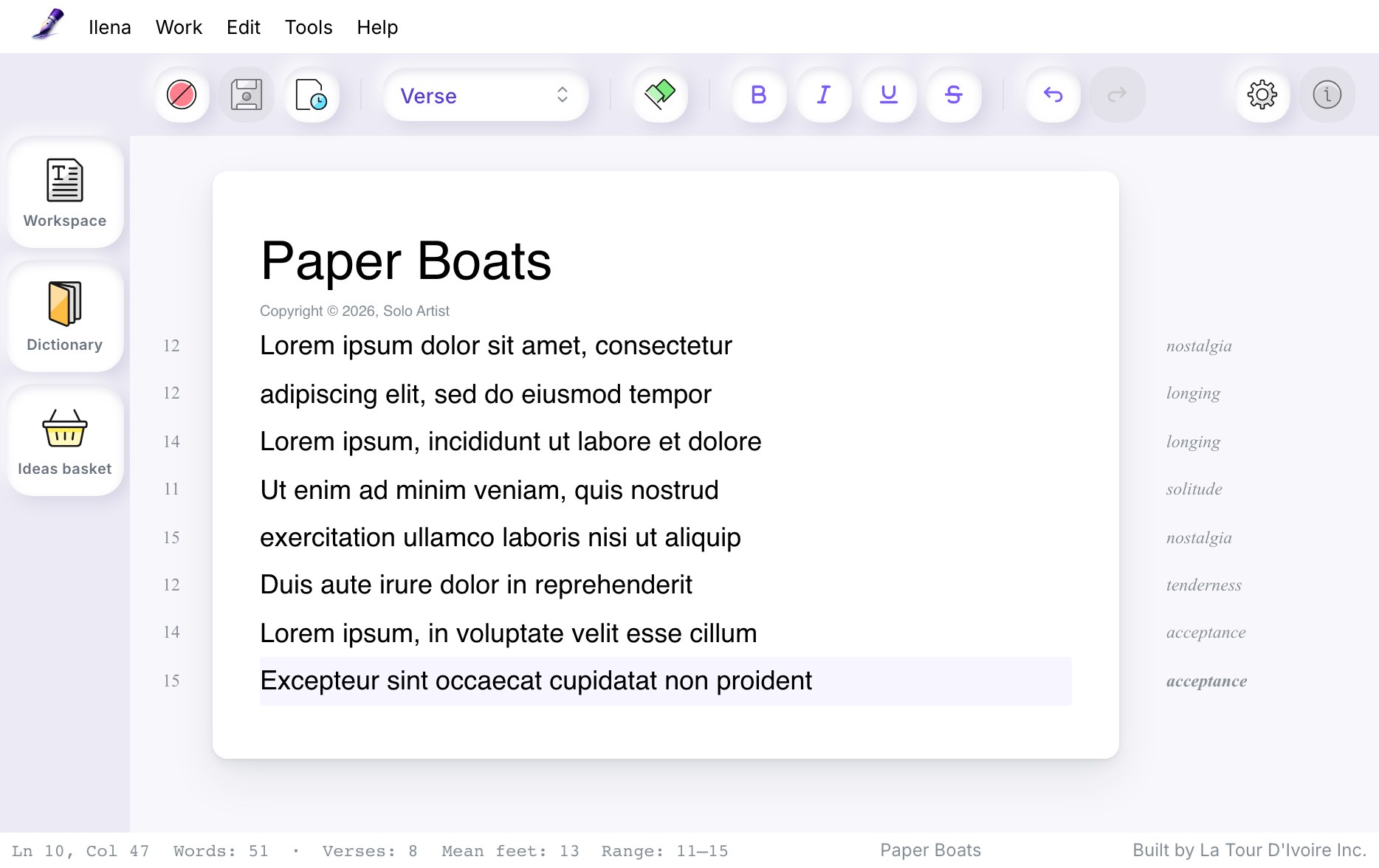
Ilena gives you a workspace built specifically for that kind of drafting, not a generic word processor repurposed for lyrics. Its rhyme visualizer color-codes rhyme families across your verse so you can see at a glance where your scheme holds and where it drifts, and its syllable counter confirms your stress patterns line up with the beat before you ever step to a mic. If you write consistently, the songwriting software built for lyricists adds version history and structured formatting so a verse in progress never gets lost between sessions. Start a draft in Ilena and run your next verse through the rhyme visualizer to see exactly where your scheme needs another layer.
Sources
- MTO 15.5: Adams, Flow in Rap Music
- Internal Rhymes Explained | Raptology
- A visual representation of rhyme schemes in rap lyrics, inclusive of multisyllabic patterns
- 14 Rap Rhyme Schemes Every Rapper Should Know
FAQ
What Are Five Examples of Rhyme Schemes?
The five most common are AABB, ABAB, AAAA, ABBA, and AXXA, each producing a different rhythmic feel depending on where the rhyme resolves.
How Should You Begin a Rap Verse?
Start with your end-rhyme skeleton mapped to your bar count before writing full sentences, then build meaning into the rhyme words you've already planted.
How Should a Rap Song Be Structured?
Most rap songs alternate verses, built on more complex or shifting schemes, with a hook that uses a tighter, more repetitive pattern like AABB for memorability.
What Makes a Rap Verse Good?
A strong verse pairs a clear rhyme scheme with layered internal and multisyllabic rhyme, places its rhymes deliberately relative to the beat, and never sacrifices meaning for a rhyme word.
Can a Tool Help Me Write My Own Rhyme Schemes?
A tool like Ilena can surface rhyme options and visualize your existing patterns, but it works as a companion to your drafting process, not a substitute for your own creative decisions.
Ilena is built to support human creativity, not replace it. Your voice, your words, your work.