Six Week Plan to Master Cadence in Rap with Ilena
Cadence in rap is the rhythmic pattern and vocal modulation an artist uses to deliver lyrics: how syllables land against the beat, where stress falls, and how tempo and pitch shift within a bar. It's the single biggest factor separating a rapper who sounds distinctive from one who sounds interchangeable, because cadence is what gives a verse its groove, tension, and release. This guide breaks down its core elements, its major styles, the academic vocabulary for timing, and a practice routine to sharpen it.
TL;DR:
- Rappers can significantly enhance their distinctiveness by mastering cadence through focused practice on timing, stress, pitch, tempo, and pauses.
- Recognizing cadence styles such as triplet flow, double-time, laid-back timing, and conversational delivery helps expand an artist's expressive options.
- Isolating cadence elements in training, like shifting stress or experimenting with off-beat timing, develops more control and nuanced vocal modulation.
- Building cadence skill requires consistent drills over weeks, including recording variations, switching rhythms within bars, and using metronomes to reinforce timing.
- Using tools like syllable counters and metrical analysis can help translate vocal experimentation into precise lyric writing and improvement.
Table of Contents
- What Is Cadence in Rap, and How Does It Differ From Flow and Rhythm?
- What Are the Core Elements of Cadence You Should Practice?
- What Are the Most Common Cadence Types in Rap?
- How Does Expressive Timing Shape a Rapper's Delivery?
- Which Exercises Build a Stronger Cadence Over Six Weeks?
- How Does Ilena Help You Refine Cadence on the Page?
- Sources
- FAQ
What Is Cadence in Rap, and How Does It Differ From Flow and Rhythm?
Rhythm is the underlying beat grid: the tempo, the meter, the pattern of kicks and snares a producer builds. Flow is how an artist's lyrics move across that grid: where the words land relative to the beat, how syllables are packed into each bar. Cadence is narrower and more personal. It's the vocal modulation, phrasing choices, and stylistic timing an artist brings to that flow, the fingerprint that makes two rappers riding the same beat sound nothing alike.
Think of rhythm as the road, flow as the route you take across it, and cadence as your driving style. One rapper might chop each line into short, clipped bursts. Another might glide through a bar with long, connected phrases that ignore the bar lines entirely.
- Rhythm: fixed by the instrumental, measured in BPM and time signature.
- Flow: the syllable pattern and pacing an artist chooses within that rhythm.
- Cadence: the personality layer, stress, pitch, and pauses that make a flow sound like you.
If your bars feel technically correct but forgettable, the problem usually isn't rhythm. It's cadence. That's the element worth isolating first.
What Are the Core Elements of Cadence You Should Practice?
Cadence breaks down into components you can isolate and drill separately, the same way a vocalist works on pitch and breath control before combining them into a full performance.
- Timing: whether syllables land on-beat or off-beat. Syncopation, placing accents between the expected beats, creates the sense of rhythmic tension that makes a verse feel alive rather than mechanical.
- Stress: which syllables get emphasized. Shifting stress from the syllable a listener expects to an unexpected one changes the entire feel of a line without changing a single word.
- Pitch: rising or dropping your vocal pitch mid-bar to punctuate a point or signal a shift in mood.
- Tempo: speeding up or slowing your delivery relative to the beat, independent of the beat's actual BPM.
- Pauses and breath: silence is a rhythmic tool. Where you breathe, and where you choose not to, shapes phrasing as much as the words themselves.
Metrical analysis of rap flow shows that the placement of accented and rhymed syllables, combined with how closely syntax lines up with the bar structure, is what creates distinct rhythmic textures from one verse to the next, according to a detailed musical analysis of rap flow techniques. No single element carries a cadence alone. It's the combination, timing paired with stress, pitch layered over tempo shifts, that produces a delivery a listener recognizes instantly.
Pro Tip: Isolate one element per practice session. Spend a full session only on stress placement, saying the same line with the emphasis moved to a different syllable each time, before you ever touch tempo or pitch.
What Are the Most Common Cadence Types in Rap?
Recognizing cadence types by ear is the fastest way to expand your own vocabulary of delivery options. Four patterns show up across most subgenres, each with its own emotional signature.
- Triplet flow: three syllables packed into the space of two beats, creating a rolling, almost melodic bounce. Common in trap-influenced verses where density and speed carry energy.
- Double-time: doubling the syllable rate over the same bar length, often used to build urgency or showcase technical control.
- Laid-back or lagging timing: syllables land slightly behind the beat, producing a relaxed, unhurried feel associated with West Coast and boom-bap traditions.
- Conversational timing: phrasing that mimics natural speech patterns, often spilling across bar lines through enjambment rather than resolving neatly at each line's end.
Few artists demonstrate cadence modulation as clearly as Kendrick Lamar, who shifts pitch, tone, and tempo within a single verse rather than settling into one pattern for the whole song. Producer Robert Glasper has pointed to that shifting voice and cadence as a defining part of Kendrick Lamar's mastery of rap cadence, often within the same eight bars.
When you listen for these styles, check three cues: does the syllable density change, does the delivery sit ahead of or behind the beat, and does the artist switch patterns mid-verse rather than riding one cadence for the full song. Those three questions will tell you more about a rapper's control than any single technical term.
How Does Expressive Timing Shape a Rapper's Delivery?
Expressive timing is the deliberate placement of syllables slightly ahead of, behind, or in loose relation to the beat, and researchers have grouped it into three categories: swung timing, lagging timing, and conversational timing. These categories give you precise language for a skill that otherwise gets described vaguely as "swagger" or "feel."
Micro-timing works at the millisecond level. Pushing a syllable a fraction ahead of the beat creates urgency and tension. Dragging it behind creates a relaxed, almost lazy groove. Neither is a mistake when it's intentional. Executed with control, expressive timing is a mark of technical sophistication, and a 2022 analysis in the Journal of Popular Music Studies treats it as a deliberate rhetorical device rather than a rhythmic error, based on its academic framework for expressive timing in hip-hop flow.
To practice this, record a verse and mark where each syllable actually lands against a click track. You'll likely find you're already using expressive timing without naming it, which is the first step toward using it on purpose.
Which Exercises Build a Stronger Cadence Over Six Weeks?
Cadence improves through repetition and self-assessment, not through inspiration alone. Practical guidance on developing rap cadence consistently points to a few core drills: recording the same verse at different rhythms, rapping over varied tempos, and using metronomes or drum loops to lock in timing, as outlined in practical advice on building rap cadence. Here's how to structure that into a progression.
- Warm up with mumble or scat. Before you write a single word, hum or mumble nonsense syllables over a beat to find rhythmic pockets. Discovering the groove vocally, before language constrains it, is a technique experienced rappers rely on often.
- Map syllables to a metronome at three BPM settings. Try a slow tempo (around 70 BPM), a mid tempo (around 95), and a fast tempo (around 140). Notice how your natural stress patterns shift with speed.
- Drill cadence switches inside a single bar. Alternate triplet flow, straight eighth notes, and double-time within the same four bars to build the muscle memory Kendrick Lamar and similar artists show off between verses.
- Record and A/B test. Cut two takes of the same bar with different timing choices and listen back critically. Ask which version carries more tension, and which resolves more naturally.
Pro Tip: Track your recordings by week. Cadence gains are incremental, and hearing week one against week six is the clearest proof that the drills are working.
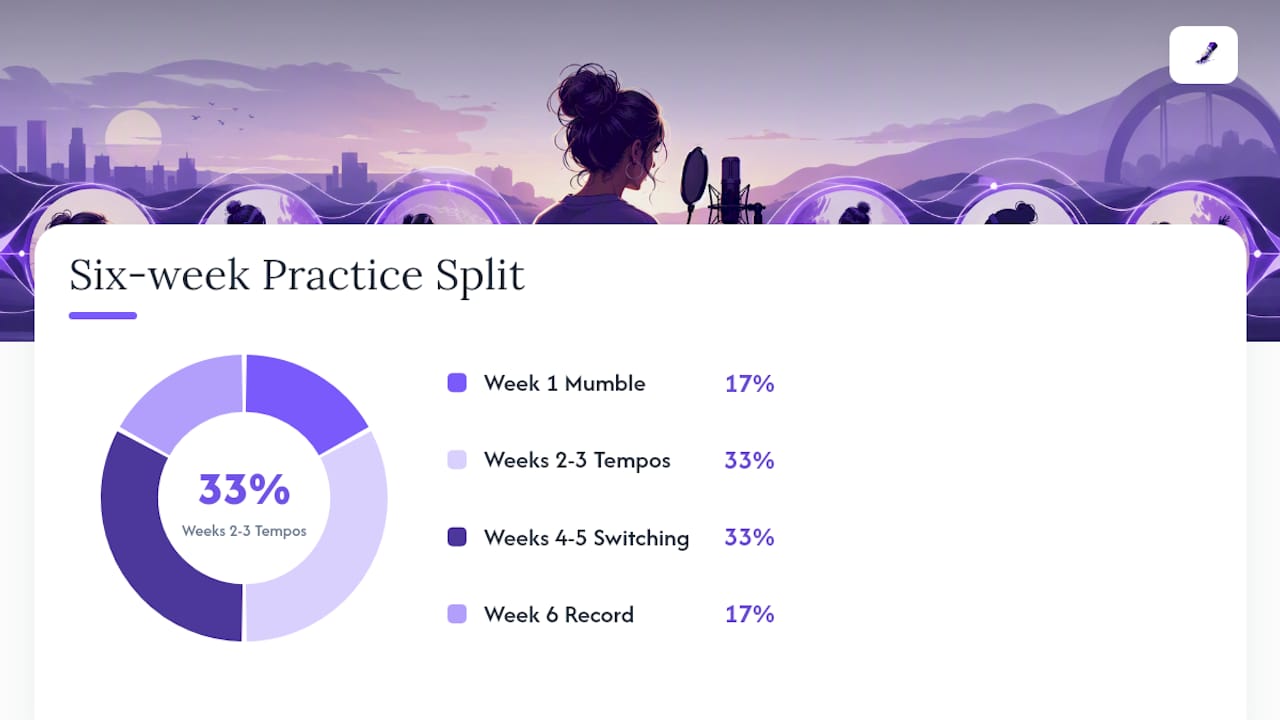
Spend week one on the mumble method and slow-tempo mapping. Weeks two and three, add mid and fast tempos. Weeks four and five, drill cadence switching. Week six, record full verses and compare against your week one takes. The most common error at every stage is rushing to add words before the rhythm actually feels natural in your body.
How Does Ilena Help You Refine Cadence on the Page?
Vocal experimentation only becomes usable once it's captured in writing, and that's where a syllable counter, meter analysis, and rhyme explorer earn their place in your process. A workable sequence: experiment with cadence out loud, note or record what worked, then use Ilena to check syllable counts against your intended meter and revise lines until the written version matches the rhythm you found vocally.
Version history lets you keep every draft of a cadence experiment without losing earlier takes, which can help you compare different versions. None of this writes your bars for you. The software analyzes and suggests; you decide what stays. If you're ready to lock a vocal cadence into a polished lyric sheet, the songwriting software built for lyricists is a reasonable next stop, alongside the syllable counter for mapping meter directly against your written lines.

Sources
For deeper study, the academic breakdown of expressive timing in hip-hop flow covers swung, lagging, and conversational timing in detail. The DJBooth profile of Kendrick Lamar's cadence work offers a practitioner's view, and listening practice benefits from transcription and analytic listening techniques used in music-based language study.
- Kendrick Lamar & The Importance of Cadence in Rap | DJBooth
- Functions of expressive timing in hip-hop flow (2022) | Journal article (JPMS)
- Metrical and articulative techniques in rap flow (2009) | Music Theory Online
- What is cadence in rap and why does it matter? | Stephen Allen Music Group
FAQ
What Is Cadence in a Song?
Cadence in a song is the rhythmic pattern and vocal delivery style an artist uses, including timing, stress, pitch, and pauses, that gives a vocal performance its distinct character independent of the underlying beat.
What Are the Levels of Skill Among Rappers?
There's no single agreed-upon framework ranking rappers into fixed tiers; skill is generally assessed across wordplay, flow, cadence control, storytelling, and delivery consistency rather than a formal numbered scale.
What Are the Main Types of Cadence in Rap?
The most common types are triplet flow, double-time, laid-back or lagging timing, and conversational timing, each producing a different emotional effect through syllable density and beat placement.
What Is the Difference Between Cadence and Rhythm?
Rhythm is the fixed beat grid set by the instrumental, while cadence is the personal vocal modulation, stress, pitch, and timing choices, an artist layers on top of that grid.
How Can I Practice Improving My Cadence?
Start with mumble or scat exercises to find rhythmic pockets, map syllables against a metronome at varied tempos, then record and compare takes to track measurable progress over several weeks.
Ilena is built to support human creativity, not replace it. Your voice, your words, your work.