The editor
This page covers what's on screen around your text: the menus, the toolbar, the gutters that read your lines as you write, and the status bar.
Menu barDirect link to Menu bar

Five menus, top left:
| Menu | Holds |
|---|---|
| Ilena | About, Settings, Quit. Quit leaves the editor for the Ilena home page without signing you out — you're still signed in when you come back. Sign out lives on the Ilena site itself, in the account menu of the site header. |
| Work | Close, Save, Export, History — for the work currently open. |
| Edit | Undo, Redo, Cut, Copy, Paste, Delete, Select All, Mark. |
| Tools | Workspace (Cmd/Ctrl+O), Dictionary (Cmd/Ctrl+D). |
| Help | Keyboard Shortcuts, Terms of Use, Privacy Policy, AI Transparency, How to get support. Documentation and Tutorials are listed but not available yet. |
ToolbarDirect link to Toolbar

Left to right: Close, Save, History, the line type dropdown,
Mark, Bold/Italic/Underline/Strikethrough, then Undo/Redo.
At the far right of the window, separate from this cluster, sit Settings
(the gear) and Documentation (not available yet).
Close, Save, History, Mark, Undo and Redo also live in the menus above, and so do Settings and Documentation — the same actions, reached two ways. The line type and the four text styles are on the toolbar only.
Line typesDirect link to Line types
Each line has a type, chosen from the toolbar dropdown:
| Type | Looks like | Use for |
|---|---|---|
| Verse | Standard body text | Your actual lyrics — the default, and the only type read by the gutters below. |
| Title | Large | Song or section titles. |
| Indication | Italic | Stage directions, performance notes. |
| Legal | Small | Credits, copyright, fine print. |
Verse lines accept emoji anywhere in the text — 🔥, 💔, flags, skin-tone variants, and other compound sequences all type and save normally. They're preserved exactly through save, reload, version history, and export, and they don't get counted as feet or as rhyme sounds by the gutters or the dictionary.
The guttersDirect link to The gutters

While you're on a verse line, Ilena analyses it a beat after you stop typing:
- Left gutter — feet. The metric foot count for that line, scanned by the rules of the work's language — not a plain syllable count. French and Spanish verse and English accentual metre are each scanned by their own rule, so the same line can carry a different count depending on the language it's written in.
- Right gutter — emotion. The dominant emotion Ilena reads in that line.
The two gutters are analysed separately: the feet count lands as soon as it's ready, without waiting on the emotion, so don't expect them to always appear together.
Both are a guide, not a verdict — treat them as a signal to check your meter or your emotional arc at a glance, not as ground truth. Only verse lines are analysed; title, indication, and legal lines show nothing in either gutter.
Correcting a feet count by handDirect link to Correcting a feet count by hand
If Ilena's count doesn't match how you actually read or perform a line, you can set your own.
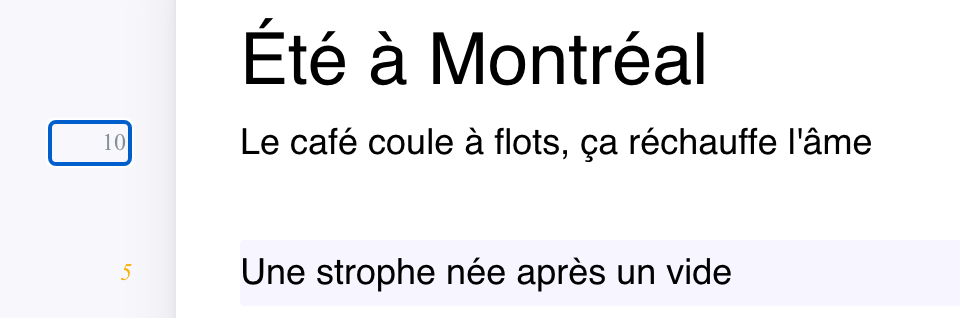
- Double-click the feet count in the left gutter.
- It becomes a small text field. Type a whole number from 1 to 99.
- Press Enter to confirm.
A count you set by hand is shown in a different colour from one Ilena calculated, so you always know at a glance which is which.
Anything else cancels and leaves the line exactly as it was — an out-of-range number, letters, an empty field, pressing Escape, or clicking away. If the line already had a manual count, cancelling keeps that value.
Your own count stays in place as long as the line's text doesn't change. Two things drop your own count, and both hand the line back to Ilena. The first is editing the text: the moment you change the wording, the override goes and the line is analysed fresh. The second is easier to trip over — changing the line's type away from Verse and back. A line that is not a verse has no feet at all, so leaving Verse discards the count along with the rest, and returning to it starts a new analysis. Your number is gone without a character having been typed.
Status barDirect link to Status bar

Along the bottom, with a work open: your cursor's line and column, the word count, the number of verses, and the open work's name. The mean and range of feet across those verses can sit there too — the feet stats start switched off, and Ilena → Settings is where you turn them on. The same place turns the cursor position and the word count off if you'd rather not see them.
Marking textDirect link to Marking text
Marking is a temporary highlight for the current editing session — useful for keeping a line in view while you work on the rest of the piece.
- Select the text you want to mark.
- Choose Edit → Mark, or the Mark button in the toolbar.
Every occurrence of that text in the current work is highlighted in yellow — the search ignores capitals, and it finds the text inside a longer word too. The toolbar's Mark button stays active for as long as the marks are up, wherever your cursor is; press it again to clear them all.
A mark is not saved and does not export. It never reaches the server — reload the page or reopen the work and it's gone, and it will never appear in an exported PDF even if it's still visible on screen right now. See Export for what does and doesn't carry into the file you download.
SavingDirect link to Saving
Ilena does not autosave — you control every version.
- Save — Cmd/Ctrl+S, Work → Save, or the toolbar button.
- Unsaved indicator — the browser tab title is prefixed with
*while the work differs from its last saved version. - Closing with unsaved changes — a dialog offers Discard or Save & Close. Dismissing it leaves the work open and unchanged.
Every save creates a new version — see History & Versions.
Undo and redoDirect link to Undo and redo
Standard undo and redo work inside the canvas, stacked for the current editing session — closing and reopening a work starts a fresh history.
Next: suggestions as you writeDirect link to Next: suggestions as you write
The canvas can also suggest how a line might continue, in two different ways. See Inspiration to turn them on and understand how each one works.