Lire en français · Leer en español
How to Write a Limerick Poem (AABBA)

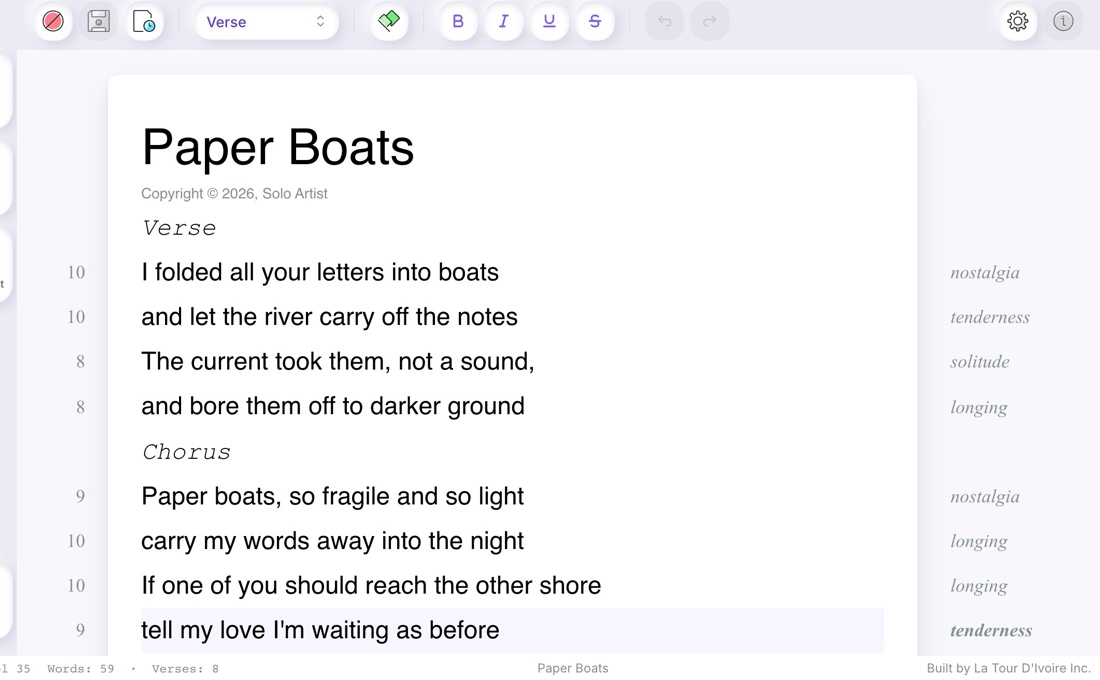
To write a limerick poem, make five lines with an AABBA rhyme scheme: lines 1, 2 and 5 rhyme, while the shorter lines 3 and 4 rhyme with each other. Give the poem a lively beat and a playful turn at the end. The easiest way to learn the form is to draft one, read it aloud, then revise what trips your tongue.
See the five-line form
Here is an original example written for this guide:
Who launched all her pies through the air.
One landed at noon
In the lap of the moon,
Which asked for a fork and a chair.
Claire, air and chair make the A rhymes. Noon and moon make the B rhymes. The middle two lines are shorter than the others, so the poem gathers speed before its last image: a moon ready to eat pie.
The beat matters as much as the letters. English limericks often use a bouncing rhythm, with roughly three strong beats in each long line and two in each short one. That is a guide for your ear, not a reason to keep an unnatural phrase just because its syllable count looks right.
Write and revise your limerick
Begin with a person, animal or object that can do something unexpected. Give it a small situation, then decide what surprising action or response could close the poem. You do not need the ending to be a joke with a punchline, but it should change how the reader sees the scene.
- Sketch the ending. Claire’s airborne pies give the moon a reason to ask for a fork. Knowing that destination helps the earlier lines lead somewhere.
- Choose the A rhyme. Find three words that fit the scene. Claire, air and chair let this example introduce the baker, send the pies flying and finish with the moon’s request.
- Choose the B rhyme. Lines 3 and 4 need their own sound. Noon and moon connect the landing to the final image.
- Read all five lines aloud. Listen for a line you have to rush or a word you stress strangely. Change the wording before you change the idea you wanted to express.
A rhyme is useful only if it serves the poem. In the example, replacing “One landed at noon” with “One landed too soon” would preserve the rhyme with moon, but it would introduce a timing problem the poem never explains. Keep noon because it makes the little scene clearer.
If your third A rhyme forces an awkward ending, explore another sound rather than sacrificing the scene. Try a word from your own draft in Ilena’s rhyme dictionary, without signing up. Find rhymes for a word in your poem (opens in a new tab)
Try the form in Spanish
The five-line AABBA pattern can inspire a Spanish poem, but translating an English limerick word for word is unlikely to preserve its rhymes or beat. Here is a separate Spanish example, written for this guide:
con corona de azúcar y miel.
Lo vio un ratón,
pidió un cucharón,
y se proclamó rey del mantel.
Pastel, miel and mantel share the A rhyme; ratón and cucharón share the B rhyme. The two middle lines are also visibly shorter. This is an adaptation of the five-line idea, not a claim that Spanish verse follows the same stress pattern as an English limerick. If you work in Spanish, listen to the Spanish lines on their own terms rather than trying to impose an English syllable count.
Frequently Asked Questions
What are the basic rules of a limerick poem?
A limerick has five lines and an AABBA rhyme scheme: lines 1, 2 and 5 rhyme, while lines 3 and 4 share a different rhyme. The middle lines are usually shorter, and the poem often ends with a playful surprise.
Does a limerick need an exact number of syllables?
An English limerick is usually guided by its bouncing rhythm rather than a single fixed syllable count. Its longer lines commonly have about three strong beats and its shorter lines about two. Reading the poem aloud helps you hear whether the pattern feels natural.
Must a limerick start with “There once was”?
No. “There once was” is a familiar opening, but a limerick can begin with any line that sets up its scene and supports the A rhyme. Choose an opening that gives your particular poem somewhere to go.
Can you write a limerick in Spanish?
You can write a five-line Spanish poem with an AABBA rhyme scheme and shorter middle lines. Spanish pronunciation and verse conventions differ from English ones, so a Spanish adaptation need not reproduce an English limerick’s exact beat or syllable pattern.