Lire en français · Leer en español
Different Types of Poetry: Choose Your Form

The different types of poetry offer different ways to shape an idea. If you want a pattern to work within, try a fixed or constrained form; if you want the line breaks to follow your thoughts, try free verse. A story may call for narrative poetry, while an image that unfolds in sentences may suit a prose poem.
Start with your intention
Suppose you want to write about finding a key in your coat after someone has moved away. Before choosing a form, ask what matters most: the small weight of the key, the moment you find it, or the story of why you still have it?
One possible opening is: “The train left; the key stayed warm in my palm.” That sentence contains a scene and a tension, but it does not yet decide the poem’s shape. You could compress it into a brief image, let it lead to a sequence of events, or follow the associations it stirs. Choosing among types of poetry forms starts with that decision, not with finding the most impressive-sounding label.
If the key feels too familiar as an image, make a short list of what surrounds it: a pocket, a door, a station, a room that no longer feels like yours. Keep only the words that bring you closer to your particular memory.
Try exploring words around “key,” then choose an image that belongs in your scene rather than one that merely sounds poetic. Explore the lexical field of “key” (opens in a new tab)
Fixed and constrained forms
A fixed form gives you rules to work within, such as a specified pattern of lines, sounds, or rhyme. Other constrained poems use a simpler rule. An acrostic, for instance, spells a word with the first letters of successive lines. The constraint can help you discover a turn you would not have written otherwise.
Here is a small acrostic built around the word “WAIT”:
The final line changes the poem’s direction: the speaker is not ready to open the door today. The acrostic supplied a structure, but the poet still had to choose that meaning. If a required letter forces a line that feels false, revise the line—or choose another form.
A haiku can invite close attention to a moment, though English-language haiku is not defined solely by a 5–7–5 syllable count. An acrostic gives you a word to build through. A limerick offers a recognizable five-line pattern and a playful turn. Each can be worth trying when its particular constraint serves your idea, rather than because every poem needs a formal pattern.
Free verse
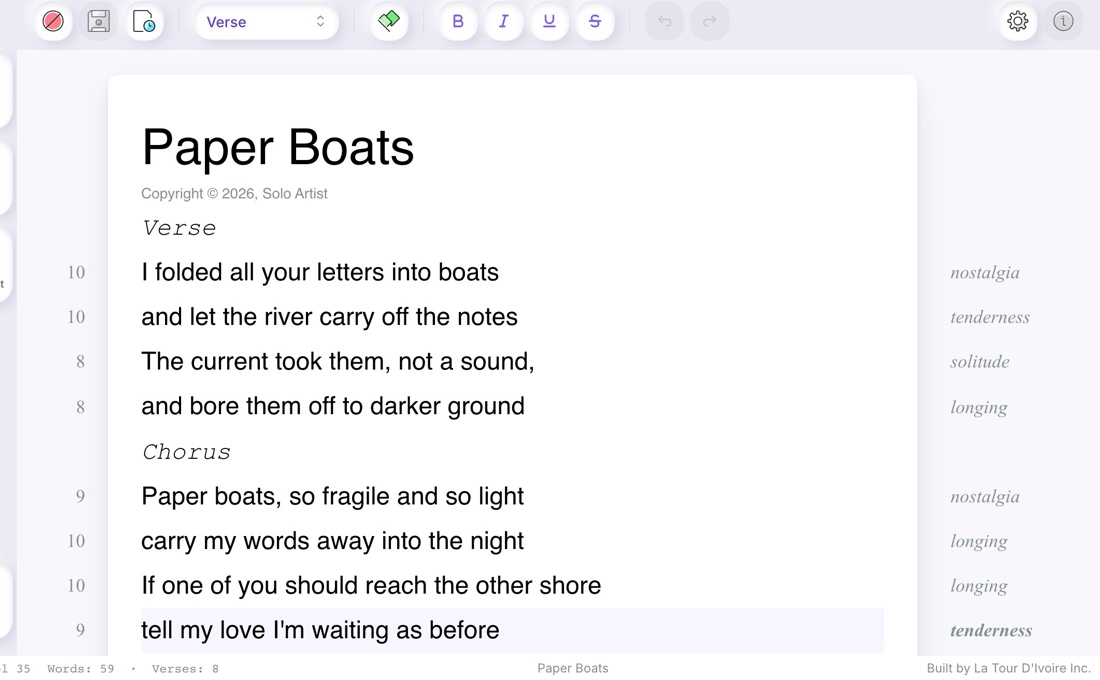
Free verse has no required rhyme scheme or fixed line length. That freedom does not make line breaks arbitrary: each one can affect what the reader notices and how long a thought hangs in the air. Return to the key and the train:
Breaking after “key” gives the object a moment on its own. “Kept the shape of a room” connects the small thing in the speaker’s hand to what has been lost. You might prefer the earlier sentence if you want a quick, direct opening; you might keep these lines if you want the reader to pause with the key.
Read free verse aloud when you revise it. Notice where you naturally pause, but do not assume every breath needs a line break. Try moving one break and ask whether it changes the meaning, the pace, or neither. If you find yourself reaching for rhyme, compare possible words against the thought you meant to express before keeping one.
A rhyme can add an echo, but it should not decide what your poem means. Look for a rhyme for “door” (opens in a new tab)
Narrative poetry
Choose narrative poetry when the events matter as much as the image. A narrative poem gives the reader something to follow: a person acts, time passes, or a situation changes. It can use rhyme, free verse, or another structure; “narrative” describes what the poem does, not one mandatory set of line rules.
For the key poem, you could begin at the station, move to the discovery in the coat, and end at the old door. You do not need to explain every part of the relationship. Give the reader enough action to understand what changes: perhaps the speaker goes to the door but decides not to use the key.
Draft the sequence in three plain sentences before arranging it as a poem. What happened first? What interrupted the speaker? What choice closes the scene? If the events interest you more than the single image of the key, this form may give the idea room to move. You can explore other poetry guides on the Ilena blog as you develop the draft.
Prose poetry
A prose poem appears in sentences or paragraphs rather than deliberately broken lines. It can still rely on concentrated imagery, sound, and surprising connections. Removing line breaks does not mean removing the care you give to each word.
Here is the same idea shaped as a short prose poem:
At the bottom of my coat pocket, the key had gathered a winter’s worth of lint. I held it through the ride home, though there was no longer a door I meant to open.
The paragraph lets the physical detail lead into the speaker’s realization without a visible pause at each turn. Compare it with the free-verse version: both concern the same loss, but the prose poem moves more like a thought remembered in one stretch. If your draft depends on the precise placement of a pause, lines may help. If it gains force by carrying the reader through a continuous sentence, try prose.
Choose a form, then revise
To choose among different types of poetry, write down your poem’s central intention in one sentence. Then draft the same moment in two shapes: perhaps four lines of free verse and a prose paragraph, or a constrained poem and a brief narrative. Keep the version that makes the important detail clearer—not simply the one that was easiest to finish.
Once you have chosen a shape, revise within it. In a fixed form, check whether a rule has pushed you toward a word you do not mean. In free verse, test a line break. In narrative poetry, remove an event that does not change the scene. In a prose poem, look for a sentence that explains what an image already shows. Your form is a way to make choices, not a test you have to pass.
Frequently Asked Questions
What are the main types of poetry?
Poetry can be grouped in several ways, including by form and by purpose. Fixed and constrained forms follow particular rules; free verse does not require a set pattern; narrative poetry tells a story; and prose poetry uses sentences or paragraphs instead of line breaks. These categories can overlap: a narrative poem can also be written in free verse.
How do I choose a poetry form for an idea?
Choose a poetry form by deciding what the reader should experience: a concentrated moment, a change of events, a pattern of sounds, or a continuous train of thought. Draft a few lines in two forms and compare what each makes clearer. The best choice is the one that supports your intention, not the one with the most rules.
Does free verse have any rules?
Free verse does not require a fixed rhyme scheme, meter, or line length. Its line breaks, sounds, and images still deserve deliberate choices. Reading a free-verse poem aloud can help you test its pace without treating every breath as a required line break.
Can a poem fit more than one category?
Yes. Narrative poetry describes a poem that tells a story, while labels such as free verse or limerick describe aspects of its structure. A story can unfold in free verse, and a poem with a constraint can also contain a sequence of events.