Lire en français · Leer en español
Songwriting Journal: Keep Ideas and Revisions

A songwriting journal gives your fragments, images, drafts and decisions a place to live, so an unfinished line does not have to depend on your memory. You can keep one on paper or digitally: the useful habit is to record what changed in a song and why.
Save the fragment before you explain it
Suppose you notice a porch light still burning in daylight. You do not need a song concept before you write down the image. A journal entry might simply say: “Porch light on after sunrise. Someone forgot it—or left it on for someone.” That small uncertainty gives you something to explore when you return.
Capture what you actually noticed, then add only enough context to recognize it later. A useful entry can contain three parts:
- The fragment: a line, image, sound, title or question, in its original words.
- The setting: where it came from, or what you were feeling when it caught your attention.
- A possible direction: one tension or perspective worth trying, without deciding what the song must become.
Use a notebook, notes app or document you can reach when an idea arrives. Recording a voice memo may help when the rhythm matters more than the words. The format matters less than knowing where to put a fragment and being able to find it again.
Keep revisions and the reasons behind them
A songwriting journal becomes more useful when it records choices, not just first thoughts. Consider this invented pair of lines:
The first version places the speaker outside, waiting. The second puts the light under the speaker’s control: keeping it on becomes a choice. It also leaves a question—who is the light for? Neither version is automatically stronger. The journal note might read: “Try the second for a speaker who cannot quite let go; keep the first if the song needs the physical scene of waiting.”
When you revise, save the earlier wording and add a sentence about the trade-off. Did you gain a sharper image but lose a gentle tone? Does a new rhyme sound good but pull the line away from what you mean? Those notes make it easier to revisit a decision without treating every edit as final.
If “wait” feels too broad, compare nearby words, then test any promising choice in your line and aloud. Compare words close to “wait” (opens in a new tab)
Make each song easy to return to
A pile of dated entries can preserve ideas and still make them hard to use. Give each developing song a working title, even if it is only “Porch light,” and keep its fragments and drafts together. If one image could belong to several songs, leave it in the journal and note which drafts you tried it in.
For each song, a short record is enough:
- Working title and date: so you can identify the draft.
- Core idea: the situation or tension you are exploring, in your own words.
- Current draft: the version you want to work from next.
- Open questions: what you have not settled, such as the speaker, a verse ending or a line that is difficult to sing.
- Next step: one specific thing to try when you return.
On paper, you might number pages and keep an index at the front. Digitally, you might use one document or folder per song and a consistent naming pattern for drafts. Choose a system simple enough that you will still use it on a day when you have only one line to save.
Give your journal and editor different jobs
Think of the journal as a place to capture possibilities and preserve your thinking. An editor is where you work on the text itself: trying a word, reading the lines together and deciding what to keep. The two can work side by side without requiring you to abandon a paper notebook or move every stray idea into a song draft.
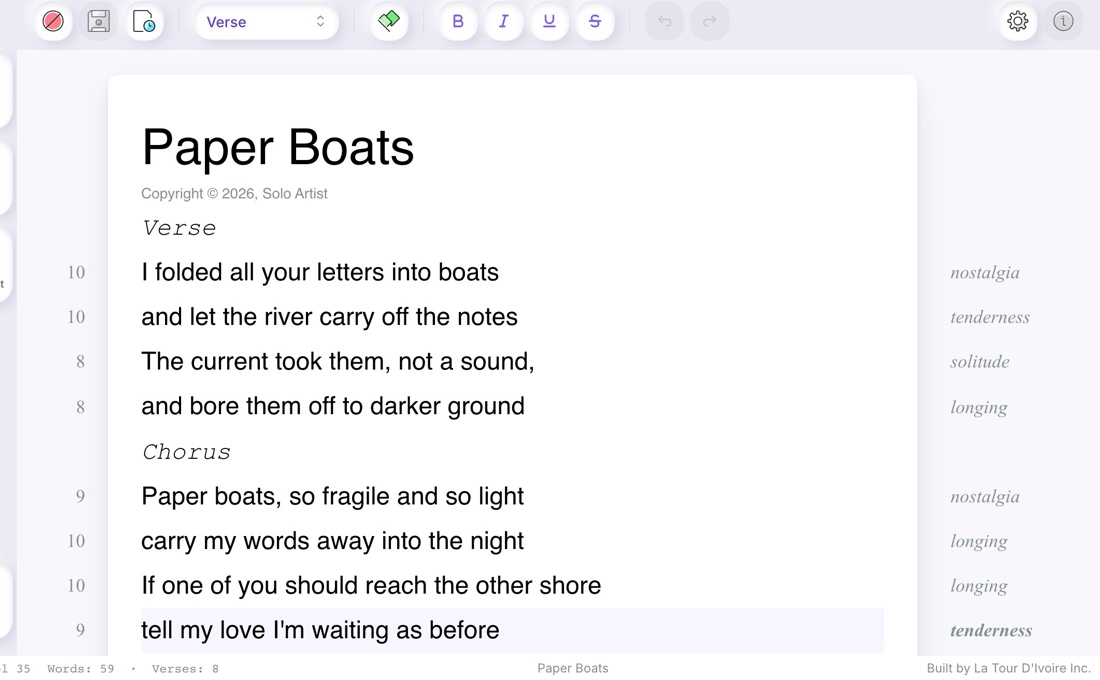
Ilena is a creative writing editor for working on your own lyrics. You can bring a fragment into the editor to develop its wording, while keeping your journal notes about earlier versions and creative decisions wherever they are most useful to you. Do not assume an editor will preserve the reasoning behind a change: write down that reasoning when you want to remember it.
For your next session, open one unfinished entry rather than starting with a blank page. Read the fragment, choose one question it raises, and write two lines that answer it differently. Save both attempts and a note about which direction you want to hear again.
Frequently asked questions
What should I put in a songwriting journal?
A songwriting journal can hold lyric fragments, images, possible titles, voice memos, drafts and notes on revisions. Include enough context to recognize an idea later, but do not wait until it sounds like a finished song.
Should a songwriting journal be on paper or digital?
Either format works for a songwriting journal. Choose one you can use quickly and search or index reliably; you can also capture ideas in one format and gather developing songs in another.
Do I need to save every version of a lyric?
You do not need to preserve every small edit. Keep versions that represent a meaningful change in image, perspective, sound or meaning, and note why you made the change if you might want to reconsider it.
How is a songwriting journal different from a lyric editor?
A songwriting journal records ideas and the thinking behind them, including fragments that may never become songs. A lyric editor is a place to work on the text of a song; you can use both without expecting either one to do the other’s job.