Lire en français · Leer en español
Songwriting Prompts That Keep the Lyrics Yours

Good songwriting prompts give you something to notice and a choice to make—not lyrics to copy. Start with a scene, a tension, a point of view or a rhythm; then write the lines yourself and keep revising until they sound like you.
Start with a scene you can observe
Try this songwriting prompt: Describe a place just after someone has left it. Don’t decide what the song means yet. Write down three details you could see or hear: a cup on the table, a door that won’t quite shut, a bus pulling away.
Choose one detail that suggests more than it states. “I miss you” names a feeling; a cup left beside the sink gives you something to write through. For example:
These original lines are a starting point, not a finished chorus. The first establishes an object; the second introduces a repeated action. You might keep that action because it feels true, or replace it with a sharper detail from your own experience. That decision is where the song begins to become yours.
If the scene feels thin, list words connected to its setting before you write another line. For a kitchen, you might consider a window, a kettle or the light above the stove. Keep only the details that belong in your scene.
A word can open up a setting without deciding what your song says about it. Explore words around your scene (opens in a new tab)
Give the scene a tension
A scene gives you material; a tension gives you a reason to return to it. Ask yourself: What does the speaker want, and what are they doing instead? Perhaps they want to call someone but keep washing the same cup. Perhaps they say they are ready to leave but have not packed.
Write both sides in plain language before trying to rhyme them:
- I want to put the cup away.
- I keep leaving it where it is.
Now write two lines that let the action carry the contradiction:
The rhyme gives the lines a connection, but it also changes the action: the speaker now leaves the cup deliberately. If that is too certain for your song, reject the rhyme and revise the thought. A useful constraint helps you discover a choice; it should not force you to keep a line you don’t believe.
Change the point of view
Another songwriting prompt is to tell the same moment from a different distance. Write one line addressed to “you,” then one that describes “them.” Read both aloud. Which lets the speaker say what they need to say—and which lets them avoid it?
The detail stays nearly the same, but the relationship changes. “You” sounds direct; “their” creates distance. Neither version is automatically stronger. Choose the one that fits the voice of this song, then check whether the rest of the verse stays in that point of view for a reason.
You can also shift time. A line about what happened yesterday may feel different when written as something the speaker still does every morning. Try each version before settling on the one that gives the song its clearest perspective.
Let rhythm shape a line
For a rhythm-based prompt, speak a sentence as you would naturally say it and mark the words you lean on. Then write a second line with a similar pattern of emphasis. You do not need a melody yet; you are listening for a shape you might want to sing.
Consider “I move your cup, then move it back.” Its repeated action makes the hesitation audible. Read a revision aloud:
The second line gives up the repetition and changes the image. It may open the verse, or it may lose the restless motion you wanted. Sing or speak both versions and decide which serves the feeling. Counting syllables can be a useful reference, but the count alone cannot tell you whether a line feels natural in a particular melody.
If you want a rhyme for a word such as “back,” look at the possibilities only after you know what the next line must do. A sound match is useful when it carries the thought forward—not when it replaces the thought.
Keep the meaning of your next line in mind while you compare sounds. Look for a rhyme for “back” (opens in a new tab)
Keep the lyrics yours
A songwriting prompt generator may offer a question or a starting scenario. Treat it as an invitation to observe, not as an instruction to have a tool write the verse. Even a useful prompt becomes personal only through the details you select, the lines you discard and the way you revise what remains.
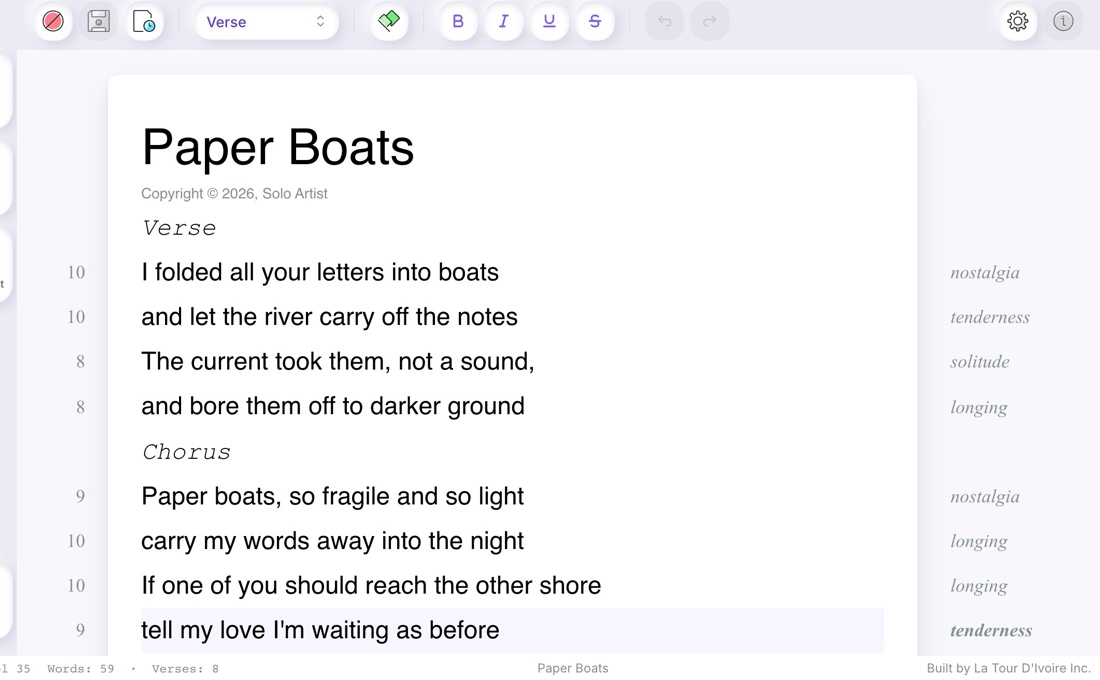
Before keeping a line, ask three questions: Would I choose this image? Do I mean what this line says? Does it sound like the speaker I’m writing? If the answer is no, change the line—even if it rhymes neatly. You can use Ilena to explore words as you revise, while making the creative decisions yourself.
Keeping those decisions in your hands is a writing practice, not a guarantee about copyright or authorship under every law. If legal rights are your concern, check the rules that apply where you live and the current terms of any tool you use.
Frequently Asked Questions
What makes a useful songwriting prompt?
A useful songwriting prompt gives you a specific place to begin, such as an object, a conflict or a point of view. It leaves room for you to choose the details and write the lines rather than supplying a finished song.
Can I use a songwriting prompt generator without letting it write my lyrics?
Yes. You can take a starting question or scenario from a songwriting prompt generator, then observe, draft and revise the lyrics yourself. Keep the details that mean something to you and set aside suggestions that do not fit your song.
Should I choose a rhyme before I write the next line?
It often helps to decide what the next line needs to say before looking for a rhyme. Compare possible rhymes against that intention, and keep one only if the meaning and sound both work for your song.
Does writing my own lyrics with an editing tool guarantee copyright protection?
No writing tool can guarantee how copyright or authorship rules will apply to every song. If you need legal certainty, consult the rules for your territory and the current terms of the tools you use.