Song Lyric Maker: What Writers Actually Need
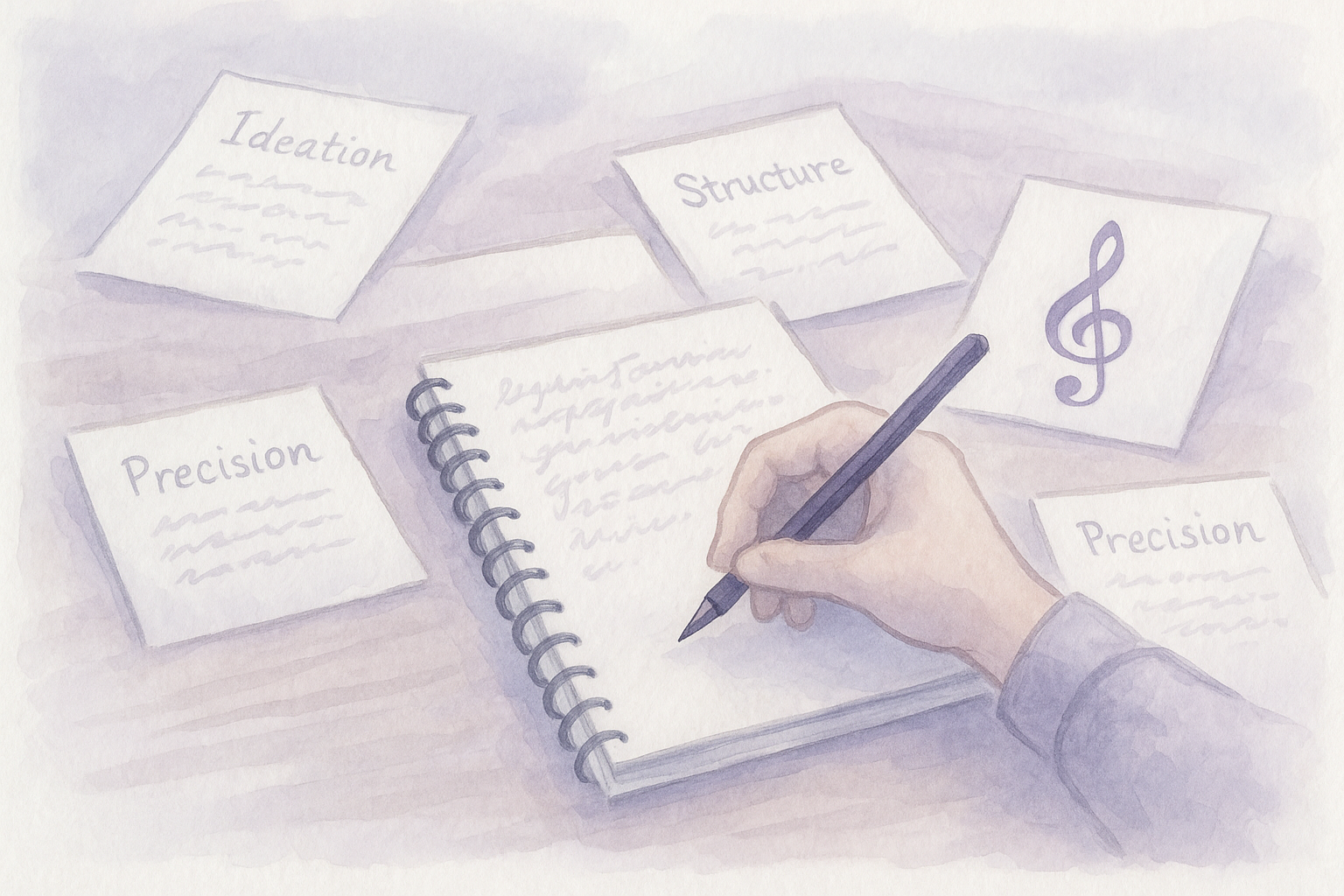
Searching for a song lyric maker often sounds like a request for a finished song. In practice, many writers are looking for something more specific: a way to develop an idea, test a chorus, find a precise rhyme, or revise a line that almost works.
What “song lyric maker” can mean
The phrase song lyric maker covers several different expectations. One person may want a tool that produces a complete lyric. Another may already have a verse and need a better rhyme for one difficult word. A third may be searching for a free way to organize and revise lyrics without losing the original idea.
Those are different writing problems. A tool designed to produce a complete text is not necessarily the best tool for comparing two lines, preserving a particular image, or making a chorus easier to sing.
That distinction matters because the writer’s role changes depending on the tool. If the tool supplies the song’s subject, images, emotional direction, and final wording, the writer may have less control over the work. If the tool helps the writer examine possibilities, the creative decisions remain with the person writing.
For many songwriters, the better question is not “Which song lyrics maker will write this for me?” It is “Which tool will help me make better decisions about my own lyrics?”
The five needs behind the search
A search for a song lyric creator free of charge may hide one or more of these practical needs.
1. Developing an idea
A song often begins with a situation rather than a complete concept: a missed train, an unanswered message, a familiar street after a breakup. The first useful step is to make that situation more precise.
Write down three concrete details before looking for lines:
- What can the speaker see, hear, or touch?
- What does the speaker want?
- What makes that desire difficult?
These questions create material without deciding the song’s meaning for you. “I miss someone” can become a particular room, an object left behind, or a message that remains unsent. Specific details give later lines something to build on.
2. Giving the lyric a structure
Writers sometimes have several strong lines but no clear movement between them. A simple structure can reveal what is missing:
- Verse: introduces a scene, memory, or situation.
- Pre-chorus: increases tension or changes perspective.
- Chorus: states the central feeling, question, or image.
- Bridge: adds a new angle or creates a turn.
This is not a rulebook. A song can use a different form, and a chorus does not have to explain everything. The purpose of a structure is to help you notice whether each section has a distinct job.
3. Finding a precise word
Sometimes the problem is not a lack of ideas but an imprecise word. “Night” may be technically correct, but “blue hour,” “streetlight,” or “the last train” may create a clearer atmosphere. The strongest alternative is not always the most unusual word. It is the one that fits the speaker, image, sound, and emotional intention.
When comparing possibilities, ask:
- Does the word mean what I want it to mean?
- Does it belong to the world of the song?
- Does it sound natural in the speaker’s voice?
- Does it create a useful sound or rhythm?
4. Working with rhyme
Rhyme can connect lines and make a lyric memorable, but a forced rhyme can weaken the meaning. Start with the important word in your line, then explore several types of connection:
- Perfect rhyme: words share a strong ending sound.
- Near rhyme: words sound related without matching completely.
- Internal rhyme: a rhyme appears within a line rather than only at its end.
- Repeated sound: consonants or vowels create cohesion without a formal rhyme.
For example, a writer might begin with:
I kept your number in the light
Long after you left that night
Light and night form a clear perfect rhyme, but the familiar pairing may not carry enough personality. A writer could keep the rhyme, replace one image, or move toward a looser sound:
I kept your number under glass
As if the years could not move past
The second version changes more than the rhyme. “Under glass” turns the number into something preserved and untouchable. It also introduces a slightly more formal tone. That may suit the song, or it may feel too literary; the writer has to decide.
5. Revising without losing the voice
Revision is not a search for the most polished line in isolation. It is a comparison between what a line says, how it sounds, and whether it belongs with the lines around it.
Read a possible revision aloud. Check its stresses, its vowel sounds, and the way it leads into the next line. A shorter line may be easier to sing, but it may also remove an image that gives the verse its identity. A stronger rhyme may make the meaning less honest. Good revision makes those trade-offs visible.
An example: from an idea to a revision
Suppose the starting idea is: someone returns to a childhood home and realizes that the place has changed.
A first draft might be:
I came back to the house tonight
But nothing felt the same
The window still was full of light
And no one knew my name
The scene is understandable, and the first and third lines rhyme. The phrase “nothing felt the same,” however, summarizes the emotion instead of showing what has changed. The final line introduces a strong idea: the house appears familiar, but the speaker is no longer recognized by it.
The writer could make the image more concrete:
I came back to the house tonight
The porch had learned new rain
The window held the same warm light
But no one knew my name
“The porch had learned new rain” is more distinctive, but it is also more figurative. Some writers may prefer its strangeness; others may want a clearer physical detail. Another revision could be:
I came back to the house tonight
New numbers marked the door
The window held the same warm light
I had not lived there anymore
This version gives the change a visible sign and makes the speaker’s displacement explicit. It also introduces a longer final line, which may require a different melody. The version with the best rhyme is not automatically the best version. The right choice depends on the song’s voice, melody, and intended emotional distance.
Practical tip: When revising a line, change one feature at a time. Try a more concrete image, then a different rhyme, then a shorter rhythm. Keeping the versions side by side helps you understand what each change gives you and what it takes away.
How Ilena supports the writing process
Ilena is an editor for creative writing. It is designed to help songwriters and poets find words, work with rhymes, and refine their texts while keeping control of the creation.
That makes Ilena useful at several points in the process. You can bring a line that feels vague, a rhyme that feels predictable, or a verse whose wording needs another pass. Exploring related words and possible rhymes can widen the field of choices. Comparing those choices is still your work: you decide which meaning, sound, and image belong to the song.
The same principle applies to line length. A counting aid can provide a useful reference when a line feels crowded or uneven. It cannot decide whether the line fits your melody, your phrasing, or the way you want the singer to deliver it. Read the line aloud and, when possible, sing it before keeping the revision.
Ilena does not need to become the author for it to be useful. Its value is in helping you examine language closely: a word’s nuance, a rhyme’s effect, or the difference between a line that explains an emotion and one that lets an image reveal it.
Choosing the right kind of tool
The right song lyric maker depends on the task you want to accomplish. Before choosing one, describe the problem in concrete terms rather than relying on the label alone.
| Your immediate need | What to look for | What to keep in mind |
|---|---|---|
| Developing a personal concept | Exercises and a process that help you identify scenes, tensions, and images | The central idea should come from your experience or artistic intention |
| Finding a rhyme | Several possibilities with room to compare meaning and sound | A rhyme is useful only when it serves the line |
| Improving a verse | Support for word choice, clarity, and line-level revision | Preserve the voice and images that make the draft yours |
| Checking line length | A counting reference alongside aloud reading or singing | Count alone does not guarantee a natural musical phrasing |
| Producing a complete lyric instantly | Be cautious about tools that promise a finished result without your involvement | A finished text may not express your experience, voice, or intention |
A free song lyric creator may be useful for trying a method before committing to it. “Free,” however, does not tell you whether the tool supports the kind of work you need, how it handles your text, or whether its suggestions fit your writing process. Look at the actual task, the product’s documented capabilities, and the amount of control you retain.
A strong lyric usually develops through several decisions: choosing an image, testing a line, rejecting a convenient rhyme, and revising until the words sound truthful. A song lyrics maker can support that process, but it should not erase it.
Frequently Asked Questions
What is a song lyric maker?
A song lyric maker is a tool or service intended to help with some part of lyric writing. Depending on the product, it may focus on ideas, wording, rhymes, structure, or complete text. The phrase alone does not show how much creative control the writer keeps.
Is a song lyric maker the same as a song lyric creator?
“Song lyric maker” and “song lyric creator” are often used for the same broad search intent. Both can refer to tools for developing or producing lyrics, so the important distinction is the actual writing process and capabilities rather than the label.
Can a free song lyric creator help with an existing draft?
Yes, a free song lyric creator may be useful for examining an existing draft if it offers relevant help with words, rhymes, structure, or revision. A tool’s price does not determine whether its suggestions preserve the writer’s meaning, so compare each possibility with the original intention.
How can I improve song lyrics without losing my voice?
Keep the original intention visible while testing one change at a time, such as a more concrete image, a different rhyme, or a shorter line. Read each version aloud and keep the wording that sounds natural for the speaker, even when it is less polished or less tightly rhymed.
What does Ilena help songwriters do?
Ilena is a creative writing editor that helps songwriters explore words and rhymes and refine their lyrics. It supports comparison and revision while the writer remains responsible for the song’s ideas, voice, and final choices.