Lire en français · Leer en español
Words That Rhyme With Me: Sound and Meaning

Words that rhyme with “me” include be, free, key, see, sea, three, tree and we. They share the same ending sound, but the best choice for a lyric or poem is the one that also belongs in the scene you’re writing.
Exact rhymes with “me”
In standard English pronunciation, “me” ends in the long ee sound. A word is an exact rhyme when its final stressed sound matches: see and sea sound alike, even though they mean different things.
Start with a small group you can actually use:
- People and relationships: be, we
- Actions and possibilities: see, free, agree
- Objects and places: key, tree, sea
- Numbers: three
“Agree” also rhymes with “me”: its final syllable is stressed and ends in the same sound. A longer word is not automatically a weaker rhyme. What matters is how it sounds in your line and what it lets you say.
Choose a rhyme that carries meaning
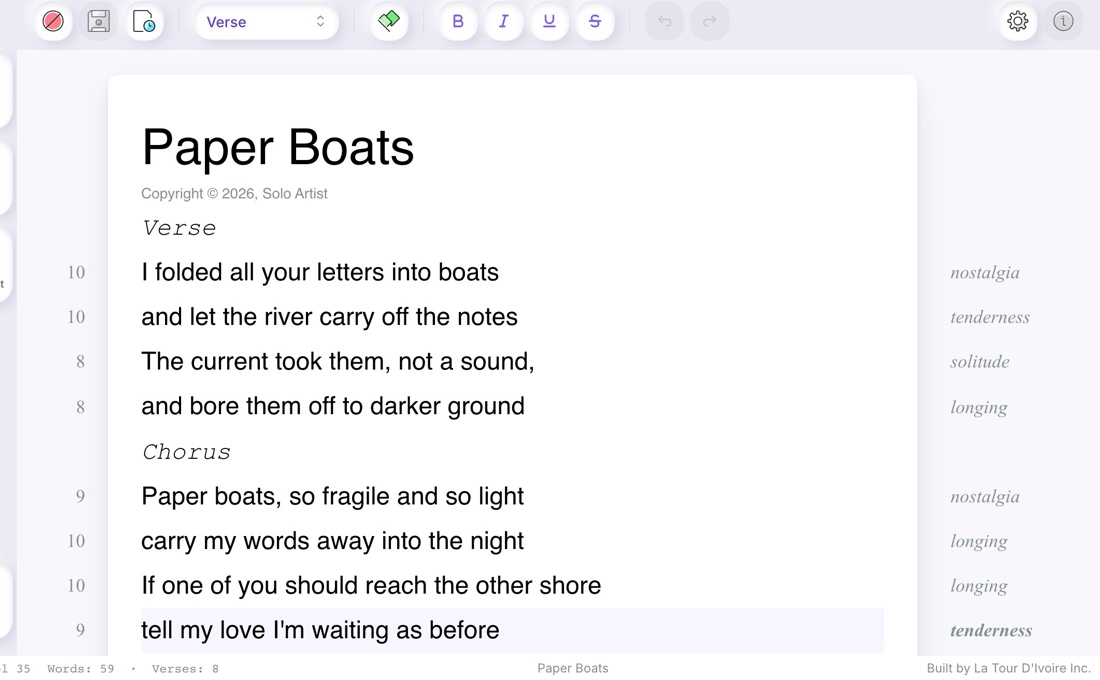
Suppose you’re writing about waiting for someone who still has a way into your life. These two lines use an exact rhyme:
“Three” gives the wait a time; “key” makes the relationship tangible. Now imagine replacing the second line with “I dreamed of you beside the sea.” Sea still rhymes, but it moves the song to a new setting and loses the key. That might be right for a coastal memory; it is less useful if the key is what makes this scene yours.
Try writing the unrhymed thought first: I kept your key while I waited. Then test words that rhyme with “me” against that thought. Can the word name something already in the scene, sharpen the feeling or reveal a choice? If not, keep the thought and change the line ending rather than forcing in a rhyme.
If you have a line ending in “me,” compare possible rhymes before choosing one that fits its meaning. You can try the rhyming dictionary with a word from your own verse, without signing up. Find rhymes for “me” (opens in a new tab)
When a near rhyme works better
A near rhyme shares part of a sound without matching it exactly. Mean and need hold onto the long ee vowel in “me,” but their closing consonants change what you hear. They can feel connected without giving the couplet a neat finish.
Read the lines aloud to hear the difference:
The first ending settles on an exact rhyme. The second is less resolved, but it tells us something new about the key and the person who left it. Neither version wins on sound alone. Keep the one whose meaning and movement suit the song.
Sound can also change when a line is sung: a held vowel may make a near rhyme more noticeable. Listen to the whole phrase, though. Stretching one syllable cannot repair a line that says the wrong thing.
Rhyming “me” in another language
Don’t carry an English rhyme list into a French or Spanish verse. French moi has a different ending sound; toi, voix and choix offer possibilities there. Spanish mí ends in a stressed i sound; sí, aquí and así can rhyme with it.
These are starting points, not translations of tree or sea. In each language, choose words for the scene you mean to write, then check how they sound in the full line.
Frequently asked questions
What words rhyme exactly with “me”?
Common exact rhymes for “me” include “be,” “free,” “key,” “see,” “sea,” “three,” “tree” and “we.” “Agree” also works because its final syllable is stressed and has the same ending sound.
Does “my” rhyme with “me”?
“My” does not rhyme exactly with “me” in standard English pronunciation. “My” ends in an eye sound, while “me” ends in a long ee sound.
Can “need” be used as a rhyme for “me”?
“Need” is a near rhyme for “me,” not an exact one: the words share a vowel sound, but “need” ends with a consonant. A near rhyme can be useful when the word expresses your meaning better than an exact rhyme.
Do French “moi” and Spanish “mí” rhyme with English “me”?
French “moi” and Spanish “mí” belong to different sound patterns from English “me.” For a French line ending in “moi,” you might consider “toi” or “voix”; for a Spanish line ending in “mí,” “sí” or “aquí” may fit. Choose within the language of the verse rather than translating an English rhyme list.