Imagery in Songs: Make Feelings Concrete
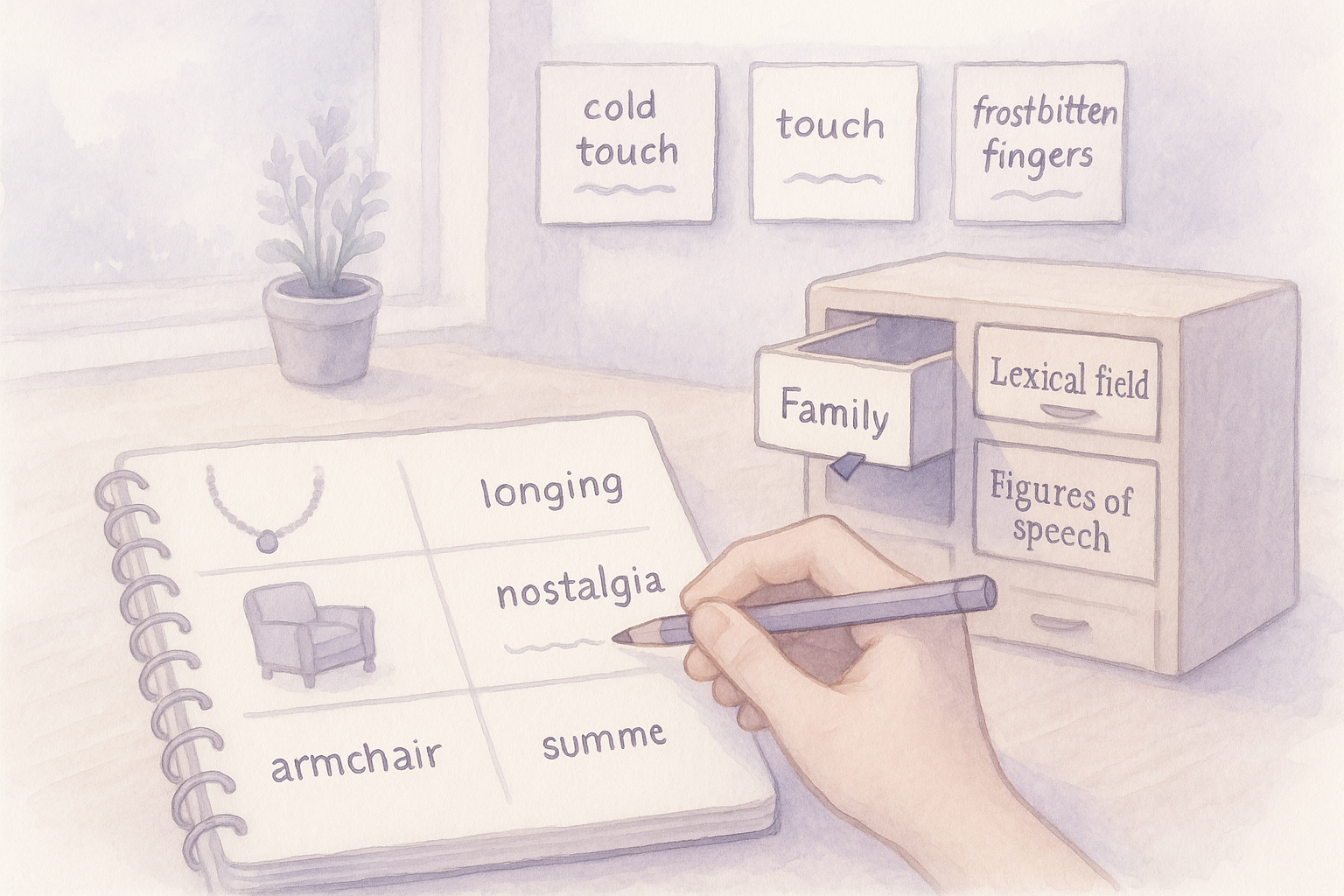
Feelings are difficult to sing when they remain abstract. Words such as loneliness, regret and hope name an experience, but they do not yet give the listener a place to stand inside it. Imagery in songs makes that experience concrete through objects, gestures, places and sensory details.
Turn an emotion into a scene
Start by naming the feeling, but do not stop there. Ask what the feeling changes in the body, what it makes the speaker do, and what might be left behind in the room.
For example, “I miss you” identifies the emotion but gives the listener little to see. A scene can carry the same feeling through a smaller, more specific moment:
I leave your blue mug by the sink
Though no one drinks from it now
The mug does not explain the entire relationship. It gives absence a shape: an ordinary object remains in its familiar place, even though the person associated with it is gone. The detail also leaves room for the listener to bring their own memory to the image.
When developing imagery in songs, move through four questions:
- What is present? Choose an object, place or visible detail.
- What is the speaker doing? A gesture can reveal an emotion without naming it.
- What can be sensed? Consider sound, temperature, texture, taste or smell.
- What has changed? Contrast often gives an image its emotional force.
Practical tip: Write down five ordinary details from a moment you remember. Do not explain what the moment means yet. Look for the detail that already contains a tension: something kept, avoided, repeated or left unfinished.
Choose details that carry feeling
A concrete detail becomes useful when it does more than identify a location. It should interact with the emotional situation. A locked door can suggest distance, but the speaker’s hand resting on the handle may suggest hesitation, while the key turning may suggest a decision.
Compare these lines:
I feel nervous when you call
The hallway light flickers twice
I count the rings before I answer
The first line tells the listener the feeling directly. The next two lines make the feeling observable. The flickering light creates an unsettled atmosphere, while counting the rings gives the speaker a small, revealing action.
There is no single correct amount of detail. Too little can make a line vague; too much can make it crowded. Try choosing one main image and one supporting sensation, then read the lines aloud to hear whether they belong together.
Here, the image of a winter bus stop supports the emotion of waiting:
Your name fogs the glass beside mine
The last bus warms the empty street
I keep one glove inside my coat
The glove is not random decoration. It gives the waiting a physical consequence and suggests that the speaker expected someone else to be there. If the song later moves to a crowded beach at noon, that change may be powerful, but it should be intentional rather than accidental.
Compare versions for precision
Revision is often a process of comparing images, not simply replacing a weak line with a stronger one. Two versions may both work while creating different emotional distances.
| Version | What it offers | Possible trade-off |
|---|---|---|
| I carry the weight of goodbye | Clear emotional meaning and a familiar metaphor | Less specific; the listener sees no particular scene |
| Your letter bends the pocket of my coat | A physical object and a quiet, intimate action | The song must establish what the letter represents |
| The envelope softens at the corners | Suggests time, handling and repeated return to the object | More indirect; it may need a surrounding line for clarity |
The most precise version is not automatically the best one. “Your letter bends the pocket of my coat” may suit a restrained verse, while “the envelope softens at the corners” may suit a slower, more reflective song. Choose according to the speaker’s voice, the melody and the emotional movement of the section.
Sound matters too. A vivid image that is difficult to sing may need a different arrangement of words. Read the line at the intended pace, listen for heavy clusters of consonants and check whether the stresses land naturally. A syllable count can be a useful reference, but it cannot decide the whole question of singability.
Use Ilena to explore concrete language
Ilena can support the language work without taking over the creative decision. When you have an abstract idea such as betrayal, relief or distance, use your own observations and word choices to look for a concrete detail connected to the idea. You remain responsible for deciding which word belongs in the song.
Write down several possible objects, actions or sensory details, then compare them with the emotional situation. This can help you examine possible figurative directions, then return to the verse and decide whether the image feels precise or merely decorative. Ilena can support this revision process, but it does not replace your judgment about the meaning of the line.
For example, you might begin with a direct line:
I am relieved that you are gone
You could then explore a more physical image:
I sleep with the window open now
The second line does not state relief. It lets an action suggest it, but it also introduces another possible meaning: freedom, recovery or even vulnerability. Compare the alternatives in the context of the verse, and keep the one that expresses the intention you want the listener to follow.
Keep the image connected to the song
One striking image is not enough to create a coherent lyric. Look at the images around it and ask whether they belong to the same emotional world. A song can change settings and sensory registers, but each shift should contribute to the speaker’s movement.
Suppose a verse begins with images of closed rooms:
The curtains hold the afternoon
Dust settles where your suitcase stood
I turn the key but leave the door
These details share an atmosphere of stillness and unfinished departure. The final action complicates the scene: the speaker turns the key, but does not fully close the door. That physical choice carries more tension than a general statement about being unable to move on.
During revision, underline the nouns and verbs in your lyric. Notice which images recur, which ones introduce a new emotional direction and which ones could belong to any song. Replace a generic detail only when the replacement adds meaning, sound or movement.
The goal of imagery in songs is not to hide every emotion behind a metaphor. A direct line can be the right choice when it provides contrast, clarifies a turn or gives the listener a simple point of connection. Let concrete details do the work where they are strongest, and let your own voice decide when to name the feeling plainly.
Frequently Asked Questions
What is imagery in songs?
Imagery in songs uses objects, actions, places and sensory details to make an experience easier to see, hear or feel. It can suggest an emotion without naming it directly, giving the listener a concrete moment to connect with.
How can I turn an abstract emotion into a lyric image?
Start by asking what the emotion makes the speaker notice, do, avoid or physically experience. Choose one specific object or action, then revise it so that it reflects the emotional situation rather than merely decorating the line.
Does a more specific image always make a lyric better?
A specific image is not automatically better because it contains more detail. The best image is the one that fits the speaker’s intention, voice, melody and surrounding lines, even when a less explicit version creates more space for interpretation.
How can Ilena help with concrete imagery?
Ilena can support the process of exploring and refining language while you work on a lyric. You decide which objects, actions and sensory details express your intention, and you remain responsible for the wording that belongs in your song.
Can I use direct emotional statements and imagery in the same song?
Yes, direct statements and concrete imagery can strengthen each other. A plainly named feeling can provide clarity, while a nearby object, gesture or sensory detail can show how that feeling exists in the speaker’s world.