Lire en français · Leer en español
How to Write Slam Poetry for the Stage

To write slam poetry for the stage, start with something you need to say to someone, then shape it so a listener can follow it on the first hearing. Give the poem a clear emotional turn, leave room to breathe, and revise it aloud. Rhyme and a fixed meter are optional; what matters is how your words land when spoken.
Start with someone to address
Imagine writing about a neighborhood where familiar shops are closing. “Everything is changing” names the subject, but it gives a listener little to hold on to. An address makes the feeling more immediate:
Now the bakery window holds a sign I can’t read from here.
These are original lines written as a teaching example. The “you” could be a neighbor, a parent, or the street itself. Before adding another line, decide who the speaker means. That choice will guide what the speaker can say honestly—and what the audience will gradually understand.
For your own poem, write one sentence beginning “I need you to know…” You do not have to use that sentence onstage. Use it to find the person you are addressing and the point you cannot leave unsaid. Then choose a concrete detail that carries some of that feeling: a window, a bus stop, a key that no longer fits.
If your first detail feels too broad, explore words around it and keep only those that belong to your scene. Explore words around your central image (opens in a new tab)
Build an emotional turn
A stage poem needs movement, not necessarily a dramatic confession. Ask what the speaker believes at the beginning and what becomes harder to believe by the end. In the neighborhood example, the speaker might begin by blaming someone for leaving, then recognize their own wish to leave too.
A simple three-part plan can help:
- Show the situation. Give the listener a place, a person, or an action they can picture.
- Put pressure on it. Let a detail challenge what the speaker first says.
- Make a choice. End with something the speaker decides to say, do, or admit—not a summary of the poem’s message.
For example, “You said the street would still know my name” could return near the end as “I said the street would still know my name.” Changing one word shifts responsibility toward the speaker. Repetition earns its place because its meaning changes.
This is one way to write slam poetry, not a fixed form. Free verse can also use turns and repetition. Here, the extra test is whether an audience hearing the poem once can sense the change without seeing its layout on a page.
Write for breath and repetition
Read each draft line aloud at a pace you could sustain onstage. Mark where you naturally breathe; do not force every written line into one breath. If an important phrase disappears between two quick thoughts, give it space before or after it.
Compare these versions of a line from the example:
The bakery is closed.
There’s a sign in the window.
I keep walking.
I don’t want to know.
The second version gives each discovery time to register, but it loses the first version’s breathless rush. Neither is automatically better. Try both aloud: choose the rush if avoidance is the point, or the pauses if you want the listener to feel each decision to keep walking.
Repeat a phrase when the audience needs to hear it differently the next time. Change its context, speaker, or emphasis. Repeating a line at the same volume and with the same meaning may make it easier to remember, but it will not necessarily move the poem forward.
When a word catches in your mouth, compare alternatives for sound as well as meaning. “Closed,” “shut,” and “boarded up” do different work: the last gives a more visible image, while “shut” is quicker to say. Keep the word that suits both the scene and your voice.
Try a few nearby words aloud before changing a line you care about. Compare synonyms for a word in your poem (opens in a new tab)
Revise aloud, then test with a listener
Make a recording of one complete reading. Listen once without looking at the page. Where do you lose the thread? Where does an image arrive too quickly? Note those places before judging your delivery: sometimes the text needs a clearer transition, not a louder voice.
Then read to one willing listener. Ask what they pictured, who they thought you were addressing, and where they felt the poem change. These questions give you more useful information than “Was it good?” You remain free to reject a suggestion that would pull the poem away from what you mean.
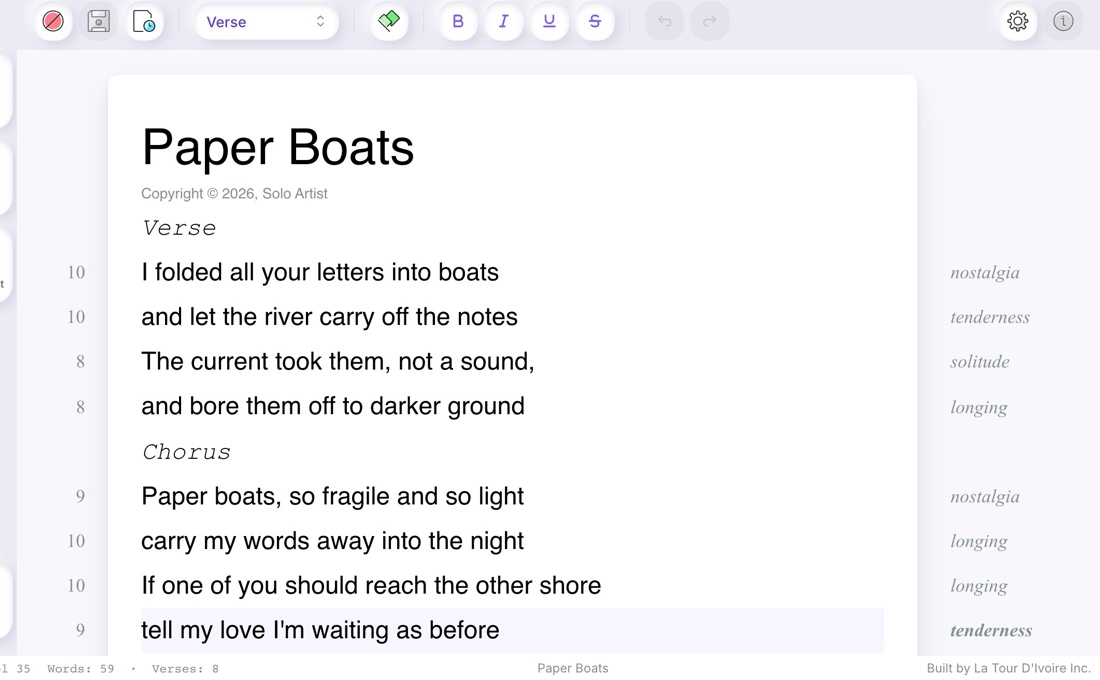
Finally, rehearse without treating one reading as the only correct performance. A pause may grow longer in a quiet room; a repeated line may need less emphasis than you expected. Ilena’s vocabulary tools can help you examine word choices, and its editor can show syllable counts while you write. Neither can tell you whether a pause will connect with a particular audience. Your spoken tests do that work.
Frequently Asked Questions
Does slam poetry have to rhyme?
Slam poetry does not require rhyme or a fixed meter. Rhyme can make a phrase memorable, but it is worth keeping only when it supports the poem’s meaning and sounds natural when spoken.
What is a good slam poetry idea?
A useful slam poetry idea begins with a specific tension you care about, such as missing a place you chose to leave. Pair that tension with a concrete moment a listener can picture, then ask who the speaker needs to address.
How can I tell whether a slam poem works aloud?
Record a full reading of your slam poem and listen without following the text. Notice where the meaning becomes hard to follow or a phrase needs more space, then ask a listener what they pictured and where they heard the poem change.
What is the difference between writing slam poetry and writing rap lyrics?
Both can use rhythm, repetition, and vivid language, but slam poetry is written to be delivered as a spoken poem, while rap lyrics are generally written in relation to musical rhythm. Neither has a single required cadence; revise for the way you intend to perform the words.