Lire en français · Leer en español
Cinquain Poem: Five Lines With Purpose
A cinquain poem gives five lines a clear purpose: each line adds to an image, and the last changes how you see it. To write one, first choose a form—syllable-counted or descriptive—then build a small scene that earns its ending.
A five-line example
Here is an original cinquain poem sample using a pattern of 2, 4, 6, 8 and 2 syllables:
The view moves from the roofs to the windows, then down to the street. The final line does not explain the scene; it gives the light a time of day. “Rain” appears twice, though, and the second occurrence adds little. In a revision, you might replace it with “mist”: The windows blur with mist. The line still has six syllables, but the image becomes less repetitive.
Two common cinquain forms
The syllabic cinquain has five lines with 2, 4, 6, 8 and 2 syllables respectively. This pattern is associated with the American poet Adelaide Crapsey. Its short final line can make an observation feel sudden, quiet or unresolved.
The descriptive cinquain is often taught as a word-count form: one word naming a subject, two describing it, three suggesting actions, a four-word phrase, and one closing word. Some versions ask for a synonym in the last line; others allow a word that reveals what the subject means to the writer. Follow the version you have been given rather than mixing its word counts with syllable counts.
For example, this original descriptive cinquain uses 1, 2, 3, 4 and 1 words:
“Welcome” is not a synonym for “lantern.” It shifts the poem from an object to the feeling that object creates. If your assignment requires a synonym, choose a different ending instead.
You may also encounter a reverse cinquain, which turns the syllabic pattern around: 2, 8, 6, 4 and 2. Name the variant you are writing so a reader knows which constraints you intend to follow.
Write your own cinquain
Start with something you can picture: a key left on a table, a bus shelter after rain, or a lamp still burning in an empty room. Write down three details you can see or hear. Then choose one change the poem will make—perhaps from absence to hope, or from an ordinary object to what it represents.
- Choose your form. Use syllables for a measured rise and short release, or the descriptive word pattern to examine a subject from several angles.
- Draft the image first. Let each line add a detail or move the reader’s attention. Do not pad a line simply to satisfy its count.
- Give the ending a job. It might name a feeling, reveal a contrast or return to the opening image with a new meaning.
- Read it aloud and revise. If a word sounds forced, try another image before changing the poem’s intention to preserve the pattern.
For a syllabic draft, you could begin with “Old key” and ask what the key opens—or no longer opens. That question belongs to you; the five-line form helps you decide which details deserve space.
Check the syllables without losing the poem
In an English syllabic cinquain, count the syllables as you would normally pronounce the words, then read the lines aloud. Pronunciation can vary, so a count is a useful check rather than a substitute for listening. In the sample above, “The windows blur with mist” has six syllables: the (1), windows (2), blur (1), with (1), mist (1).
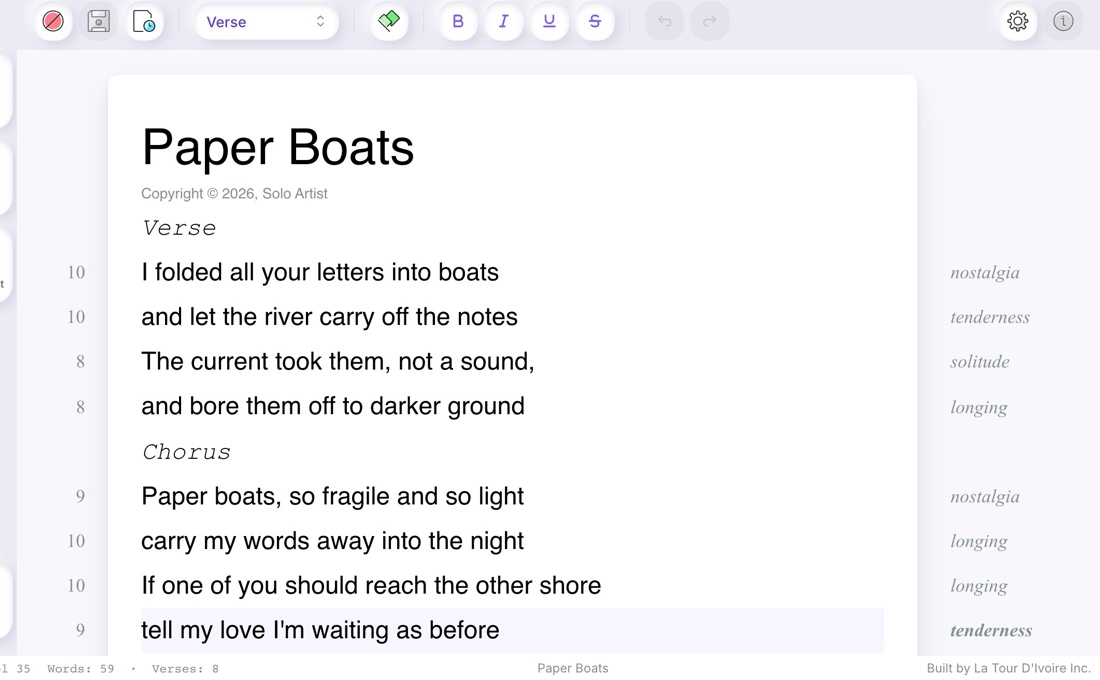
Ilena’s editor shows the syllable count of each line while you write. You can use that count to spot a line worth revisiting, then decide whether the new wording still says what you mean. It does not choose the poem’s images or its ending for you.
Once you have a five-line draft, check its syllables and read it aloud before keeping a revision. Check your lines’ syllables in Ilena (opens in a new tab)
These English examples should not be treated as rules for Spanish verse. Spanish grammatical syllables and poetic syllable counts can differ: sinalefa may join vowels across words, and the final word’s stress can change the metrical count. If you write a cinquain in Spanish, establish the intended convention before checking its lines.
Frequently Asked Questions
Does a cinquain poem have to rhyme?
No. A cinquain poem does not require rhyme; its five-line structure and the chosen variant’s rules shape it. You can use rhyme if it strengthens the meaning, but there is no need to force it.
Is a cinquain counted in words or syllables?
It depends on the variant. A syllabic cinquain commonly uses 2, 4, 6, 8 and 2 syllables, while a classroom descriptive cinquain often uses 1, 2, 3, 4 and 1 words. Check which form your assignment requests before counting.
Must the last word of a descriptive cinquain be a synonym?
Some descriptive cinquain templates require a synonym for the subject; others permit a word expressing its significance. If you are following a specific assignment, use its rule. Otherwise, choose an ending that gives the subject a meaningful turn.
Can I use English cinquain syllable rules for a Spanish poem?
Not without checking the intended convention. Spanish poetic meter can join vowels across words through sinalefa and adjust the count according to the final word’s stress. Those rules can make a metrical count differ from a count of grammatical syllables.