Assonance Examples: Shape Emotion With Vowels
Assonance examples show how repeated vowel sounds can give lyrics a particular colour, movement, or sense of cohesion. The technique does not require every word to rhyme, and it does not ask you to sacrifice meaning for sound. Instead, it offers another way to listen to a line while you revise it.
What assonance does
Assonance is the recurrence of a vowel sound across nearby words. Unlike end rhyme, it does not depend on matching the final sounds of lines. A line can therefore feel connected without sounding overly regular or predictable.
Vowel sounds can influence the character of a phrase. A repeated sound may make a line feel open, bright, rounded, narrow, gentle, or insistent. The effect depends on the sound itself, the surrounding consonants, the meaning of the words, and the way the line is spoken or sung.
Assonance is not a rule that every word must follow. A few related sounds may be enough to give a couplet or refrain a shared texture. The goal is not to decorate a line after it is finished, but to notice how sound can support the intention already present in the writing.
Five assonance examples
The following examples make the repeated vowel sound easy to observe. They are useful models for listening, but they are not formulas to copy into your own lyrics.
| Sound | Example | Words identified in the example |
|---|---|---|
| /eɪ/ | “the rain in Spain stays mainly on the plain” | rain, Spain, stays, mainly, plain |
| /iː/ | “fleet feet sweep by sleeping geeks” | fleet, feet, sweep, sleeping, geeks |
| /oʊ/ | “go slow over the road” | go, slow, over, road |
| /ɛ/ | “hear the mellow wedding bells” | mellow, wedding, bells |
| /uː/ | “a true blue moon” | true, blue, moon |
In the first example, the repeated /eɪ/ sound links several words across the line. In the second, the /iː/ sound creates a strong audible thread. The other examples demonstrate the same principle with /oʊ/, /ɛ/, and /uː/. These labels identify the sounds supplied for each example; they are not a substitute for listening to the complete line.
Listening exercise: Read one example slowly, then read it at a natural pace. Notice which words seem connected by their vowel sound before you decide what effect the line has on you.
Revise without losing meaning
Assonance becomes useful during revision when a line already has a clear intention but does not yet have the sound you want. Begin with your existing draft. Identify the word or image that must remain, then list a few alternatives for the surrounding words. Compare them for meaning before comparing them for sound.
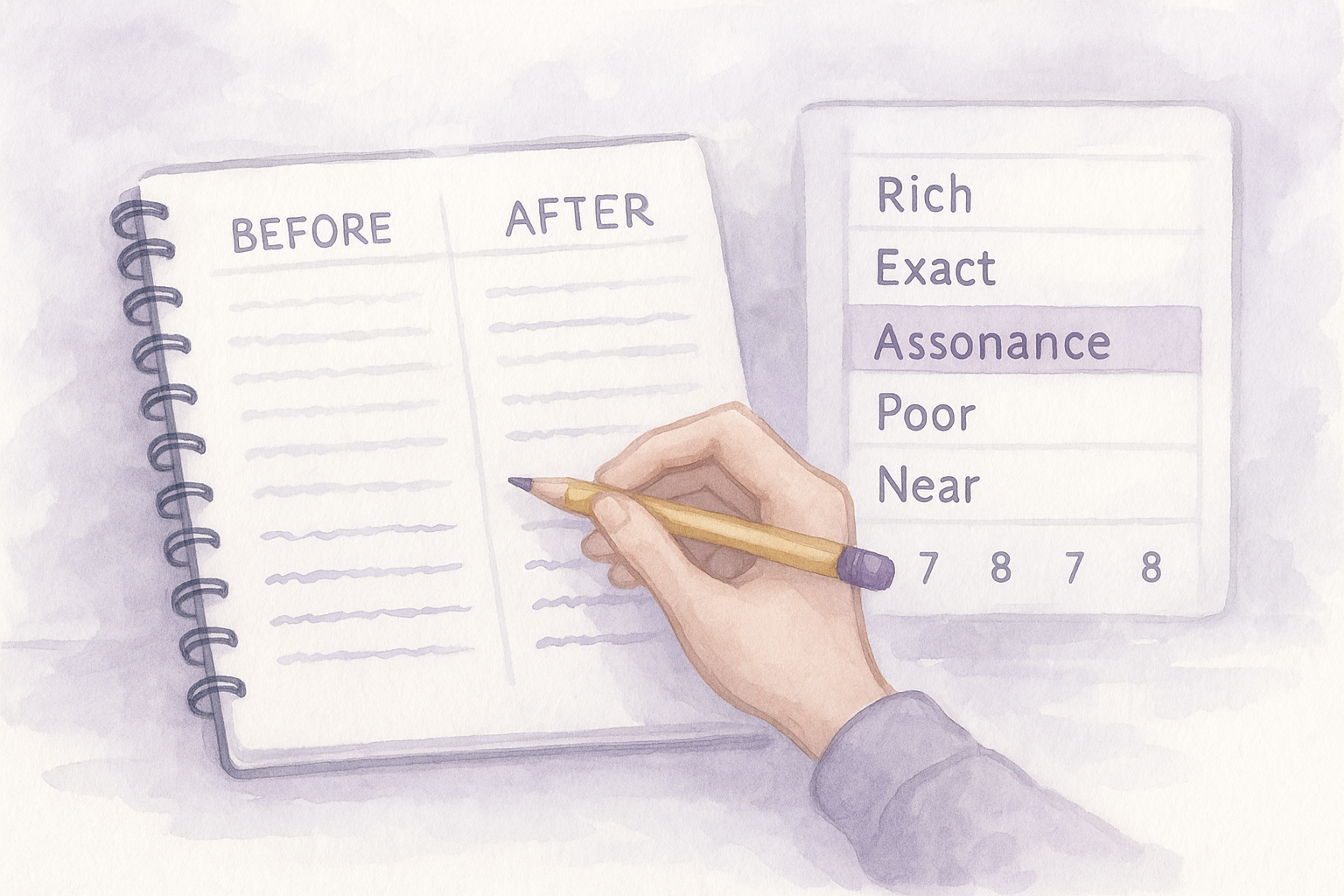
A practical before-and-after process does not require replacing an entire line. The “before” is your current wording. The “after” is one revised version that keeps the central image while introducing a more coherent vowel pattern. If the revised line sounds smoother but changes the emotional meaning, it is not automatically the better choice.
For example, you might keep the central noun in a line and test different verbs around it. One verb may be more precise but produce a sharper sound; another may create a more flowing sequence but weaken the image. Write both versions down and say them aloud. The useful question is not “Which one has more assonance?” but “Which one serves the line I am trying to write?”
You can make the same comparison in a refrain. Keep the repeated idea stable while testing small changes in nearby words. A vowel pattern can help the refrain feel unified, but variation may be important if the lyric needs a change in tension or perspective.
Assonance also works alongside other sound choices. You may notice a partial rhyme, a repeated consonant, or a change in the length of a phrase at the same time. Treat each observation as information rather than a command. A line with fewer matching sounds may carry the voice, image, or emotional turn more effectively.
Use Ilena as a comparison tool
When you have several possible words for a line, Ilena can support the comparison stage without taking authorship away from you. In its rhyme drawer, Assonance is one of five categories, alongside Rich, Exact, Poor, and Near. You can use that category to explore the kind of rhyme relationship you want to examine, then decide which option fits your meaning and voice.
The gutter also displays the number of feet in each line. Treat that number as a reference while you compare versions. It can help you notice that a revision changes the line’s length, but it does not decide whether the line is expressive or suitable for your melody.
A careful workflow is simple:
- Keep your original line visible while considering alternatives.
- Examine the available rhyme category that matches the sound relationship you want to explore.
- Compare each possibility for meaning, tone, and image.
- Check the number of feet shown in the gutter as one additional reference.
- Read or sing the selected version and keep it only if it still sounds like your writing.
Ilena can help you look at options, but the creative decision remains yours. No category or count can determine the emotional value of a word, the importance of an image, or whether a revision belongs in your lyric.
Common mistakes to avoid
Choosing sound before meaning. A repeated vowel can make a line memorable, but a beautiful sound cannot repair an image that is vague or untrue to the song. Protect the word that carries the emotional information.
Forcing every nearby word to match. Too much repetition can make a line feel mechanical. Leave room for contrast, especially when the lyric needs a change in mood or emphasis.
Confusing assonance with an end-rhyme requirement. Assonance concerns a repeated vowel sound, while rhyme can involve the sound at the end of a word. They can appear together, but they do not perform the same role.
Trusting a visual count without listening. The number of feet shown in Ilena’s gutter is a useful reference, not a verdict on how a line will sound in performance. Read the complete passage aloud and make the final decision with the voice and intention of the lyric in mind.
Frequently Asked Questions
What is assonance in songwriting?
Assonance is the repetition of a vowel sound in nearby words. Songwriters use it to connect phrases through sound without requiring every word to share an end rhyme.
How is assonance different from rhyme?
Assonance focuses on repeated vowel sounds, while rhyme usually describes a broader sound relationship, often at the ends of words or lines. A lyric can use assonance without creating a full end rhyme.
Should every word in a line use the same vowel sound?
No. Assonance does not require every word to repeat the same vowel sound. A selective pattern can create cohesion while leaving enough variation for natural language and clear meaning.
How does Ilena help when I am working with assonance?
Ilena’s rhyme drawer includes Assonance as one of five categories, alongside Rich, Exact, Poor, and Near. Ilena’s gutter also displays the number of feet in each line, which you can use as a reference while comparing your own revisions.
Can assonance make a lyric more emotional?
Assonance can influence the colour and flow of a lyric, but it does not create emotion by itself. The emotional effect still depends on the writer’s images, meaning, phrasing, and performance choices.