Fix Telling Lines for Lyricists: Show Don t Tell Checklist, 3 Drills

"Show, don't tell" in lyrics means replacing a stated emotion with a concrete image or action that lets the listener infer that feeling themselves. Instead of writing "I am lonely," a showing line might read "the toothbrush by the sink is still facing your side." Success looks like this: a listener can picture the moment, not just recognize the word for it.
TL;DR:
- Showing lines often involve specific objects or actions that can be filmed, providing concrete evidence of emotions instead of abstract labels.
- Replacing feeling words with sensory details, objects, or incremental revelations enhances emotional resonance and listener engagement.
- Balancing clarity and subtlety is key; placing explicit details early in the song and using repetition allows complex scenes to unravel gradually.
- Overusing vague objects or metaphors can dilute emotional impact, so choosing meaningful, specific details is essential for effective showing.
- Consistent practice with targeted drills and tools that analyze syllable count and prosody will improve a songwriter’s ability to craft vivid, memorable lyric scenes.
Table of Contents
- What Does "Show, Don't Tell" Mean in Lyrics?
- A Quick Checklist for Turning Telling Into Showing
- Techniques and Examples for Rewriting Telling Lines
- Keeping Showing Lines Musical: Prosody and Meter Checks
- Revision Drills That Build the Showing Instinct
- When Telling Actually Works Better Than Showing
- Common Mistakes Writers Make With Telling vs. Showing
- Balancing Narrative Clarity With Poetic Subtlety
- Showing Techniques Across Music Genres
- How Showing Lines Affect Listener Engagement
- How Ilena Supports Practicing and Shipping Show-Don't-Tell Lyrics
- Sources
- FAQ
What Does "Show, Don't Tell" Mean in Lyrics?
The phrase gets thrown around so often in songwriting workshops that it risks becoming an empty mantra rather than a working technique. Here's the precise mechanics of it: telling names an internal state directly ("I'm sad," "I miss you," "I feel free"). Showing gives the listener sensory or behavioral evidence and trusts them to arrive at that same conclusion on their own.
This isn't a rule against ever naming a feeling. It's a discipline about when naming a feeling earns its place on the page, and when it's a shortcut that costs you a more resonant line.
The clearest diagnostic for the difference comes from what songwriting educators call the scene test: if a lyric line could be filmed, meaning it contains an observable action, a specific place, or a decision someone makes, it's likely showing. If a camera would have nothing to point at, the line is probably telling. "I am lonely" fails the scene test instantly. There's no shot for it. "The toothbrush by the sink is still facing your side" passes: a camera could hold on that object for three seconds and a listener would feel the absence without a single abstract word.

That's the whole engine of the technique. You're not decorating an emotion with imagery. You're finding the object, gesture, or moment that already contains the emotion, and then getting out of the way.
Songwriters sometimes conflate showing with "being poetic," which leads to overwrought metaphor instead of specificity. The goal isn't ornate language. It's concreteness. A showing line about heartbreak doesn't need to be beautiful. It needs to be true to a moment, the way songwriting analysis of "Fast Car" and "Back to Black" shows Tracy Chapman and Amy Winehouse building entire emotional arcs out of ordinary objects and small, specific actions rather than declarative statements about how the narrator feels.
A Quick Checklist for Turning Telling Into Showing
Run this during a first draft cleanup or a dedicated revision pass. It takes five to ten minutes per verse if you're honest with yourself about which lines are hiding behind abstraction.
- Run the scene test on every line. Can this be filmed? If there's no visible action, place, or object, flag it.
- Swap the feeling word for a behavior or object. "I'm anxious" might become "I keep checking the door."
- Add a time or place crumb. A single detail like "3 a.m." or "the parking lot behind the diner" anchors an otherwise floating line.
- Recount syllables after every swap. A more concrete line is often longer than the abstract one it replaced, so check it still fits the melody.
- Decide, line by line, whether telling should stay. Some flagged lines belong in the chorus or title precisely because they're direct.
That last step matters more than songwriters usually admit to themselves.
Pro Tip: Keep a running list of "banned" abstract words for a single writing session (lonely, broken, free, empty). You'll be forced to find the image instead of reaching for the label, and most of those images will be sharper than the word ever was.
Techniques and Examples for Rewriting Telling Lines
Four reusable patterns cover most of what showing actually requires on the page.
Object anchors. Choose an item that already carries cultural or emotional weight rather than a neutral prop. A wedding ring, a house key, a worn-out ticket stub, a specific brand of cigarette: these objects arrive pre-loaded with meaning, so the line does double duty. Songwriters like Tracy Chapman and Lorde consistently turn ordinary items into load-bearing images that perform emotional work no adjective could manage alone. An object becomes evidence for a feeling instead of a decoration next to it.
Sensory detail. When a line feels flat, run through the five senses fast: What would this moment smell like? What sound is happening just off-frame? What's the exact texture under a hand? You don't need all five in one line, but interrogating each one usually surfaces the detail that makes the scene real.
Incremental revelation. Rather than explaining a situation fully in verse one, release facts gradually across verses so the same repeated chorus line gains new weight each time it returns. Practitioners note this pattern across pop and country writing: a small image in verse one, an escalating detail in verse two, and the chorus, unchanged in wording, lands completely differently by the final pass.
Paired rewrites. Seeing the swap side by side clarifies why it works.
- "I'm not okay" → "I laughed at the wrong part of the movie again." (The action reveals distraction and distress without naming either.)
- "You broke my heart" → "I still set two plates out of habit." (A daily gesture makes the loss ongoing, not just an event.)
- "I miss home" → "The porch light's on a timer I never reset." (Specific and slightly mundane, which makes it feel lived-in.)
If a lyric lacks a person, a place, and an action a listener could picture, it is probably still telling rather than showing, no matter how sincere the sentiment behind it.
Each rewrite above trades a label for evidence, and evidence is what lets a listener feel like they discovered the emotion rather than being handed it.
Keeping Showing Lines Musical: Prosody and Meter Checks
A rewrite that reads beautifully on paper can collapse the moment you sing it if you ignore prosody. Concrete language tends to run longer than abstract language, so every showing swap needs a meter check immediately after the rewrite.
- Count syllables against the original line. If "I am lonely" (four syllables) becomes an eight-syllable image, you'll need to trim function words or split the line across two bars.
- Match stressed syllables to strong beats. Sing the line against the existing melody and listen for where the natural word stress lands versus where the downbeat falls.
- Watch for crowded consonant clusters on fast passages; specific nouns (toothbrush, doorframe, streetlight) often carry more consonants than the vaguer words they replace.
- Use small melodic tweaks instead of lyric compromises when possible: lengthen a vowel on a held note, or shave an unstressed article ("the," "a") rather than gutting the image itself.
A before→after example: "I feel so alone tonight" (six syllables, even stress) becomes "the porch light's still on, waiting" (seven syllables, with the stress landing hard on "light" and "wait"). One extra syllable is a minor adjustment; six extra syllables would demand a structural rewrite, not a tweak. A syllable counter built for lyrics makes this check nearly instant instead of a manual tally on your fingers.
Revision Drills That Build the Showing Instinct
Showing isn't a rule you apply once. It's a habit you train the way a musician trains scales, through short, repeatable sessions rather than occasional bursts of effort.
- 10-minute sensory-writing sprint. Pick one ordinary object in your room and write for ten minutes using only sight, sound, smell, touch, and taste, no feeling words allowed. Daily sensory-writing exercises like this one build the reflex to reach for the image before the label.
- Scene-test rewrite sprint. Pull five telling lines from an old draft and convert each into a filmable scene in 20 minutes. Don't aim for perfect; aim for filmable.
- Verse continuity drill. Choose one object and carry it across three verses, letting its meaning shift slightly each time it reappears, echoing how incremental revelation works inside a chorus.
Tool-assisted features like those offered by Novel with AI can shorten the distance between a rough swap and a finished line without making a single creative decision for you. A rhyme finder surfaces variations you wouldn't reach for on your own, which matters when a fresh object anchor doesn't rhyme with your existing chorus. A vocabulary explorer helps you land on the exact noun that carries the right cultural weight, the difference between "car" and "pickup" in a line about leaving home. None of that replaces the judgment call about which image belongs in the song. It just clears the mechanical friction out of the way.
Pro Tip: Run the same object through three synonyms before committing. "Ring," "band," and "gold circle" carry three different emotional registers even though they point at the same object.
When Telling Actually Works Better Than Showing
Showing should dominate a lyric, but a well-placed telling line can outperform ten showing lines in the right spot. The chorus is the most common exception: a short, direct ring phrase often works as the song's emotional thesis precisely because it names the feeling the verses have been building evidence for. Practitioners point to this pattern in tracks where a repeated plain chorus line gains weight each time new concrete facts arrive in the surrounding verses.
A bridge is the other natural home for telling. After two verses of accumulated imagery, a direct statement can resolve ambiguity the listener has been sitting with, turning a mood into a stated realization.
- Use telling in a title when the phrase itself needs to be searchable, memorable, or instantly graspable.
- Use telling in a chorus hook to anchor the emotional thesis after verses have shown the evidence.
- Reserve one telling line for a bridge reveal rather than spreading direct statements throughout.
- Let telling punctuate a showing-heavy lyric rather than dominate it; a whole verse of stated feelings reads as a lyric sheet, not a song.
The safeguard is simple: if you can count more than one or two telling lines per section, you're leaning on the crutch the technique is meant to help you set down.
Common Mistakes Writers Make With Telling vs. Showing
The most frequent mistake isn't overusing telling. It's overcorrecting into imagery so dense that the listener loses the emotional thread entirely. A verse stuffed with five unrelated objects reads as clever rather than felt, because nothing gets room to land.
A second mistake is choosing objects with no inherent weight. A "table" or a "car" without a specific detail attached does none of the emotional work a "toothbrush still facing your side" does. Vague specificity is a contradiction; an object needs a detail that only makes sense in this relationship, this house, this breakup.
Writers also frequently confuse showing with metaphor overload. A line dense with three stacked metaphors is often just telling dressed up, since the listener still has to decode an abstraction rather than picture a scene. The scene test catches this: if the metaphor can't be filmed, it hasn't actually solved the telling problem.
Another common error is abandoning showing the moment a rhyme gets difficult. A songwriter finds a strong image, can't rhyme the last word, and swaps back to a generic feeling word purely for the rhyme scheme. This is usually a vocabulary problem, not a genuine creative tradeoff, and it's solvable with a broader synonym search rather than a retreat to abstraction.
Finally, some writers show relentlessly in verses but never let the chorus state anything directly, leaving listeners with atmosphere but no anchor. A song needs at least one moment where the accumulated evidence resolves into a clear emotional statement.
Balancing Narrative Clarity With Poetic Subtlety
The tension every lyricist eventually runs into is this: enough concrete detail to feel specific, but not so much that the story becomes hard to follow on a single listen. Unlike a poem read silently and reread at will, a song usually gets one pass through a listener's attention before the chorus needs to land.
The fix is sequencing, not simplifying. Put your clearest, most legible information early, typically the first line or two, since a small, specific detail placed early is what hooks a listener before the more oblique images arrive later in the verse. Once that anchor is set, you've earned some slack for subtler or more compressed imagery in lines three and four, because the listener already has a scene to hang them on.
Repetition is your other tool for balancing the two demands. A chorus that repeats the same words verbatim can afford to be more direct precisely because the verses around it are doing the showing work; the chorus becomes the clarity, the verses become the texture. This is the same incremental revelation pattern that lets a fixed chorus phrase deepen in meaning each time new detail lands in the surrounding verse. Clarity and subtlety aren't opposing goals here. They're sequenced, with concreteness up front and interpretive room built in behind it.
If a listener can't answer "what is this song about" after one pass, dial back the subtlety in your opening image, not your whole lyric. If every line spells out the plot, push abstraction into your third verse instead of your first.
Showing Techniques Across Music Genres
The mechanics of showing don't change across genres, but the acceptable density of imagery does, and matching that density to genre convention is part of the craft.
Country rewards object anchors more than almost any other genre, since the tradition already runs on trucks, dirt roads, and porch lights carrying emotional freight. A country lyric can lean harder on a single, well-chosen object across an entire song and trust the listener to track it.
Pop favors economy: one strong image per section, delivered fast, because pop's structure moves quickly and doesn't have room for accumulated detail the way a slower genre does. The scene test matters most here, since pop has the least tolerance for a line that doesn't earn its place.
Folk and singer-songwriter traditions tolerate, and often reward, incremental revelation across multiple verses, letting a single object's meaning shift gradually the way it does in narrative songwriting built for close, repeated listening.
Hip-hop often shows through specificity of place and brand rather than sensory abstraction: a street name, a car model, a specific year functions the same way a toothbrush by the sink does in a ballad, as concrete evidence standing in for a stated feeling.
R&B and soul frequently pair showing verses with a telling hook sung with enough vocal conviction that the direct statement feels earned rather than lazy, which is the vocal performance doing work the lyric alone can't.

Across all five, the underlying discipline is identical: concrete evidence over stated feeling. Only the ratio and the vehicle change.
How Showing Lines Affect Listener Engagement
Listeners connect more strongly with lyrics that let them do interpretive work rather than lyrics that hand them a conclusion. Sensory-writing practitioners point out that listeners frequently lack precise language for their own feelings, and a song that supplies the label ("I'm sad") can't compete with one that supplies the evidence and lets the listener recognize their own experience inside it.
This is why showing lines tend to reward repeat listens better than telling lines do. A stated emotion is exhausted the first time you hear it; there's nothing left to notice on pass three. A concrete image, by contrast, can reveal a new layer of meaning once a listener has more context, which is exactly how incremental revelation across verses turns a repeated chorus line into something that lands harder by the final pass than the first.
The engagement cost of over-telling isn't dramatic. It's quiet. A lyric that states its feelings plainly from start to finish isn't unpleasant, it's just forgettable, because it asks nothing of the listener and gives them nothing to hold onto after the song ends. Concrete detail is what a listener actually remembers a week later: not "she was sad," but the toothbrush still facing the wrong side of the sink.
How Ilena Supports Practicing and Shipping Show-Don't-Tell Lyrics
Every drill above gets faster with the right tools, as long as those tools stay in a supporting role. Ilena is built specifically for that division of labor: it's a writing companion for lyricists, not a lyric generator, so the creative decisions in every rewrite still belong entirely to you.
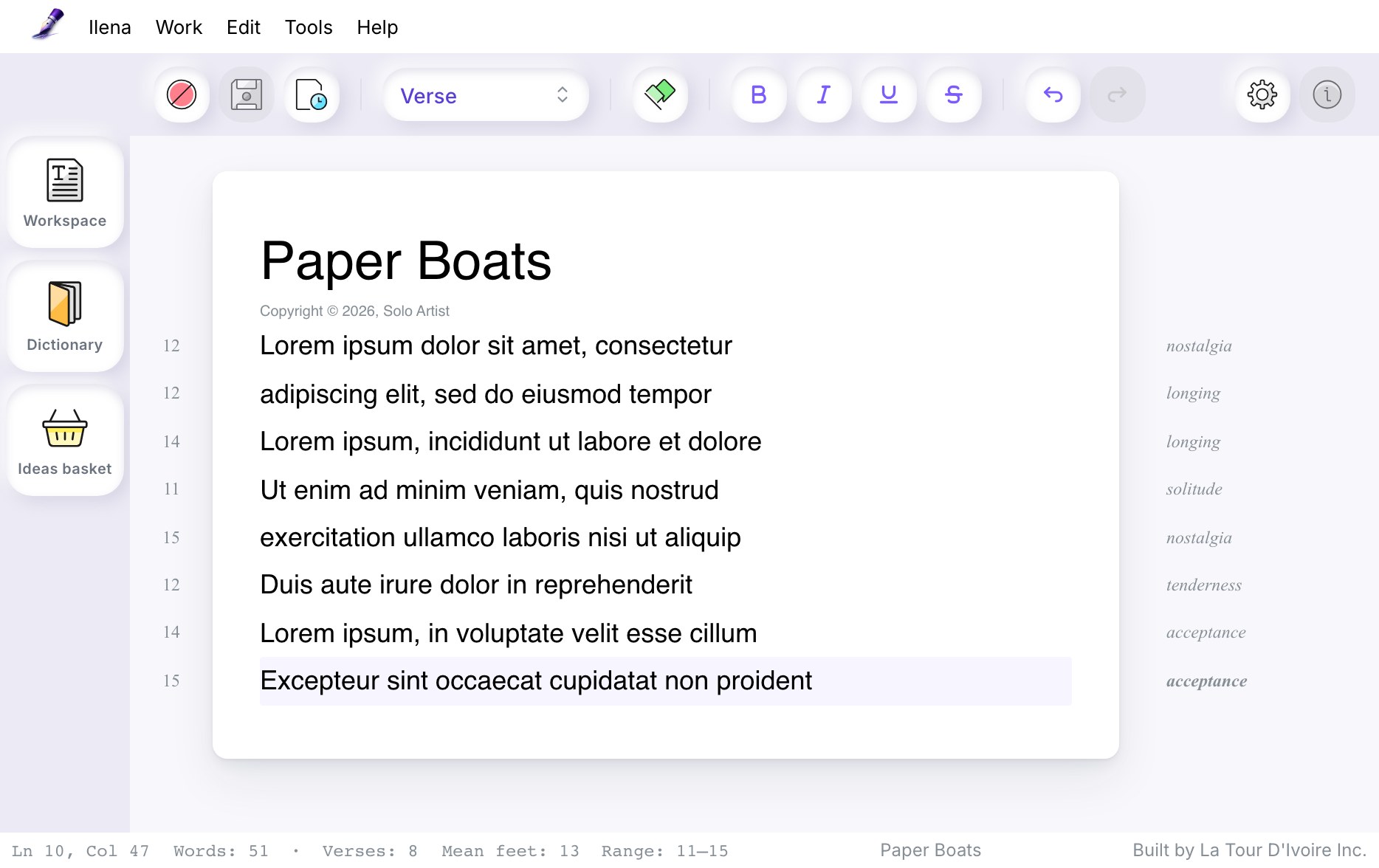
The feature set maps directly onto the exercises in this guide. A rhyme discovery tool speeds up the object-anchor swap when your strongest new image doesn't rhyme with the line before it, surfacing variations you'd spend minutes hunting for manually. Its syllable and meter analysis handles the prosody check from the section above instantly, so you know within seconds whether a longer, more concrete line still fits the melody. The word explorer helps you land on the exact noun with the right cultural weight instead of settling for the first synonym that comes to mind. Version history means you can run the scene-test rewrite drill freely, since every earlier draft stays recoverable if a rewrite doesn't land.
For lyricists working with a band or a co-writer, collaboration tools let everyone weigh in on which object anchor lands hardest, without losing track of who suggested what across a dozen revisions. If you're ready to run these drills with tools built for the job, Ilena's songwriting software is worth trying on your next draft.
Sources
For deeper technique breakdowns, Simon Onsongs' explainer on show, don't tell covers the object-anchor swap in detail. Liminl's scene test writeup is the clearest diagnostic explainer available for identifying telling lines. Andrea Stolpe's sensory-writing exercises offer the most practical daily drills for building the showing instinct, and Music Connection's expert advice column breaks down real chart examples of the technique in action.
- How to Write Specific Lyrics — The Scene Test | liminl.
- Getting started with sensory writing | Andrea Stolpe
- Show, Don't Tell — Expert advice (Music Connection)
FAQ
What Is the "Show, Don't Tell" Technique in Songwriting?
It means replacing a stated feeling with a concrete image, object, or action that lets the listener infer the emotion themselves, verified with the scene test: if a line can be filmed, it's showing.
How Do I Know if a Lyric Is Telling Instead of Showing?
Apply the scene test: if the line contains no observable person, place, or action a camera could capture, it's telling rather than showing.
Should I Ever Use Telling Lines in a Song?
Yes. A short, direct telling line often works best in a chorus hook, title, or bridge reveal, where it functions as the song's emotional thesis after the verses have supplied the evidence.
Can Rewriting for "Show, Don't Tell" Hurt My Song's Meter?
It can, since concrete language often runs longer than abstract language; recount syllables and recheck stress placement after every swap, using a tool like Ilena's syllable counter if you want an instant check.
Does "Show, Don't Tell" Work the Same Way in Every Genre?
The underlying discipline stays the same, but the acceptable density of imagery shifts: country and folk tolerate heavier object-anchoring, while pop favors one strong image per section delivered quickly.
Ilena is built to support human creativity, not replace it. Your voice, your words, your work.