Lire en français · Leer en español
Refrain vs Chorus: What Changes in a Song?

A refrain and a chorus can name the same repeated part of a song, but they do not always mean the same thing. In some songwriting traditions, a refrain is a short line that returns within the verses, while a chorus is a separate section that returns between them. The clearest way to describe your song is to show where the words repeat.
Hear the difference in a song draft
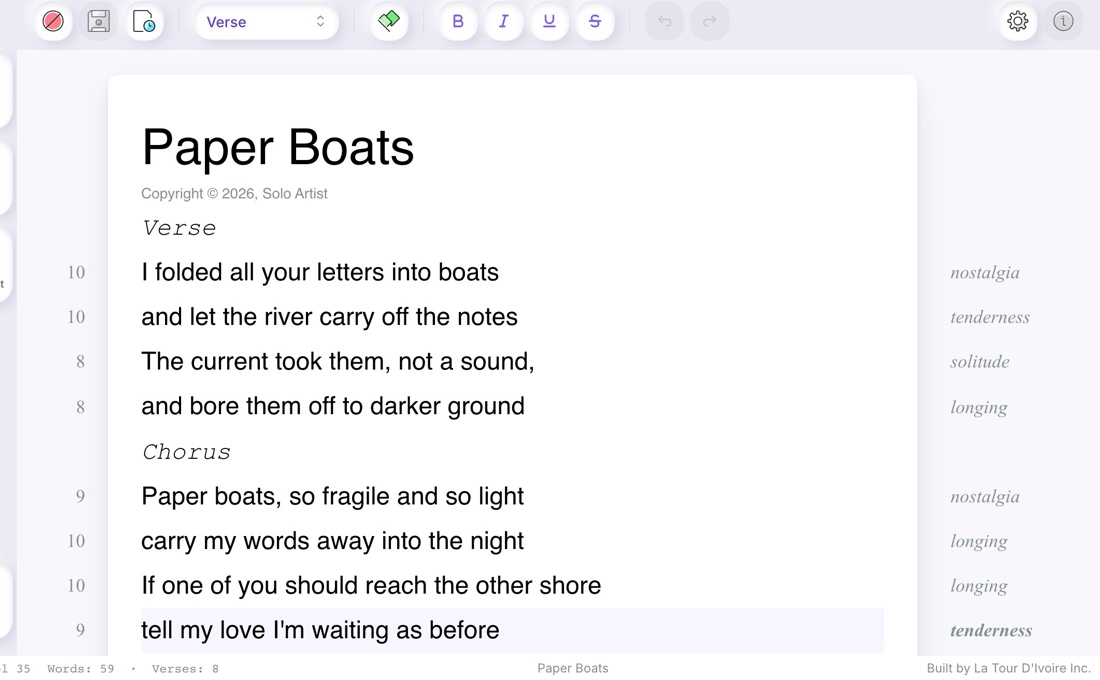
Imagine a song about leaving a familiar town. Each verse tells a different part of the story, but ends with the same line. These lines are original examples written for this article:
“I could still turn back” is a refrain in the sense of a recurring line embedded in the verses. It changes meaning slightly as the story moves forward: in the first verse, the speaker might return to a place; in the second, perhaps to a person.
Now imagine a separate section after each verse:
That section is a chorus: it has its own place in the song’s structure and returns after the verses. It gathers the song’s central tension rather than advancing the scene one detail at a time. A songwriter might call this section a refrain, too. The useful distinction here is structural, not a rule that every musician must follow.
Why the terms change with context
In many conversations about popular songs, refrain and chorus are interchangeable names for the recurring main section. In other contexts, a writer uses refrain for a repeated line or phrase within a verse and reserves chorus for a standalone section. If a collaborator uses the words differently, look at the draft together: does the passage sit inside each verse, or does it occupy its own section?
The distinction does not transfer neatly between languages. In French, refrain commonly names the recurring section contrasted with the couplet (verse); an English-speaking writer might call that section a chorus. In Spanish, estribillo and coro often overlap in use, although preferences vary by place and musical context. Neither language supplies a universal one-word test for whether a repeated passage is a line or a whole section.
Where the hook and bridge fit
In refrain vs chorus vs hook, the hook answers a different question: what part is especially memorable? A hook might be a lyric, a melody or another musical idea. It can appear in a chorus or in a short refrain within a verse; it is not necessarily a section of its own. The repeated line “I could still turn back” could become the song’s hook if its words and musical setting make it the part listeners remember.
In refrain vs chorus vs bridge, a bridge usually introduces contrast or a new perspective rather than serving as the song’s main recurring passage. A song need not have one. If the speaker in the example finally steps off the bus and faces the person they left, that change in perspective could give a bridge a purpose. Calling a passage a bridge, though, does not make it effective: its words and music must earn the turn.
Label sections to guide a revision
Write a simple map beside your draft: “Verse 1 — repeated line — Verse 2 — repeated line,” or “Verse 1 — Chorus — Verse 2 — Chorus.” The labels are working notes, not a verdict on your genre. They help you spot what each return is doing.
Then read the repeated words in sequence. Does the line gain a new shade of meaning after each verse, as “I could still turn back” does? Keep it in the verses if that changing context is the point. If your song needs a fuller statement listeners can return to between scenes, try a separate chorus. You may find that one strong repeated line is enough; adding a chorus just to satisfy a template could weaken it.
Once you have mapped the sections, revise the words in the song itself: keep a repeated line only if it still serves your intention at every return. Work on your own song draft in Ilena (opens in a new tab)
When sharing the draft, label the sections and, if needed, add a note such as “repeated line at the end of each verse.” That small clarification is more useful to a collaborator than insisting on one definition of refrain.
Frequently Asked Questions
Are a refrain and a chorus the same thing?
Sometimes. Songwriters may use both words for a song’s recurring main section, but refrain can also mean a shorter line or phrase repeated within the verses. Describing where the passage appears is clearer than assuming everyone uses the same label.
Can a song have a refrain without a chorus?
Yes. A song can repeat a line within its verses without adding a separate chorus section. That recurring line can connect the verses while taking on a different meaning as the story develops.
Is a hook always in the chorus?
No. A hook is a particularly memorable lyric, melody or other musical idea, not a required section of a song. It may appear in a chorus, in a repeated line within a verse or elsewhere.
What do “refrain” and “chorus” mean in French and Spanish?
In French, refrain commonly refers to the recurring section between couplets, much like “chorus” in English. In Spanish, estribillo and coro often refer to overlapping ideas. Usage varies, so a section map helps when writers work across languages.