AI Lyrics Creator: What It Helps With, What It Breaks, and What to Use Instead
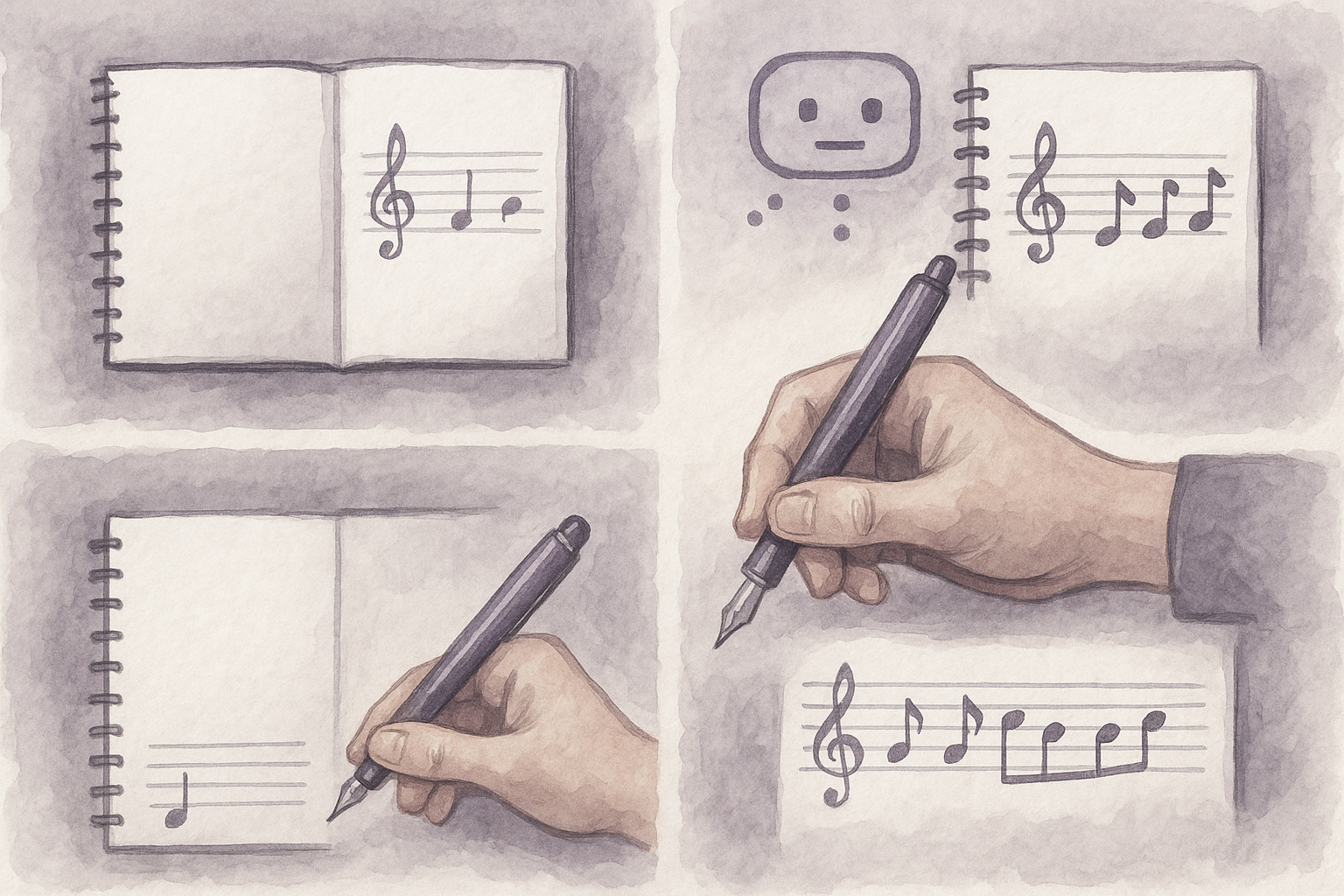
Searching for an AI lyrics creator usually means you want help getting from a blank page to a workable idea. That can be useful—but generating a complete lyric is not the same as writing a lyric that sounds like you.
What an AI lyrics creator can help with
An AI lyric creator can be useful when you need a quick starting point. Depending on the tool, it may suggest themes, lines, rhyme patterns, or complete sections based on a short description. This can help you see possible directions before you decide what the song is really about.
The main benefit is range. A blank page gives you no alternatives; a generated draft may give you several images, structures, or emotional angles to react to. Even rejecting a suggestion can clarify what you do not want to say.
There is also a practical benefit for experimentation. A lyrics maker may help you notice that an idea could be more concrete, that a repeated phrase is doing too much work, or that a chorus needs a clearer contrast with the verse. Those observations become valuable only when you evaluate them yourself.
The limitation is that a list of possible lines is not yet a finished song. A lyric still needs a point of view, a reason for each image, and a relationship between its sound and meaning.
What raw generation can break
Full lyric generation often hides the most important creative decisions. When a tool produces a verse, pre-chorus, and chorus in one step, it may also decide the subject, emotional distance, imagery, rhyme style, and conclusion for you.
That can create several problems:
- Generic language: familiar phrases may sound polished while saying very little specific about your experience.
- Uneven point of view: the speaker may shift from intimate to dramatic without a deliberate reason.
- Forced rhymes: a line may end neatly while losing the meaning or natural phrasing you wanted.
- Unclear rhythm: a line can have a similar syllable count to another line and still feel awkward when sung.
- Weak revision: replacing an entire draft makes it difficult to understand which change actually improved the song.
There is a creative cost as well. If the tool makes the central choices, you may spend more time accepting or rejecting its language than discovering your own. The result can be usable, but it may not feel connected to the reason you began writing.
Generated text also requires careful review. A phrase that sounds original at first may resemble familiar songwriting language, and a polished line can still be unsuitable for your voice, genre, audience, or melody. No tool can remove the need to read, speak, sing, and revise your own words.
Generation versus targeted assistance
Generation and assistance solve different problems. Generation tries to supply a large part of the text. Assistance helps you work on a decision you have already identified, such as finding a more precise rhyme or shortening a line that feels difficult to sing.
| Approach | What it offers | What remains your responsibility |
|---|---|---|
| Full lyric generation | A fast draft or several sections built from a broad description | Choosing the point of view, checking the language, reshaping the structure, and making the result personal |
| Targeted writing assistance | Focused options for wording, rhymes, vocabulary, or line length | Deciding what the line means and which option belongs in the song |
| Manual revision only | Maximum control over every word and change | Finding alternatives when you are stuck or repeating the same vocabulary |
Ilena belongs to the targeted-assistance side of this distinction. It is a creative writing editor for lyricists and poets: a place to explore words, work with rhymes, and refine lines while keeping control of the creation. It does not replace the author’s intention with a complete song.
That distinction matters if you are looking for an alternative to an AI lyrics maker. The alternative is not necessarily “write everything alone.” It can be a more focused workflow in which the tool supports a specific part of the writing process and you remain responsible for the meaning.
A better way to revise lyrics
Start with a concrete situation rather than a broad topic. “Heartbreak” is a subject; “the coat still hanging behind the door after someone leaves” gives you an image, a setting, and a possible emotional tension.
Write a rough line in your own words. Do not try to make it clever immediately. Then identify the decision you want to work on: a stronger image, a less familiar word, a rhyme that preserves the meaning, or a line that fits the way you hear the melody.
For example, imagine that your first line is:
The room is quiet since you went away
I keep looking at the door every day
The second line explains the feeling, but “every day” is broad and the repeated idea of looking may not give the scene enough detail. You might revise it toward a more concrete image:
The room is quiet since you went away
Your coat still turns the hallway grey
The revision changes the image and the rhyme. It is not automatically better: the grey hallway introduces a different mood, and you may prefer the directness of the first version. The useful question is whether the coat belongs to your song and whether the darker image matches the emotion you intend.
This is where targeted assistance can help. In Ilena, you can explore possible rhymes or related wording for a line, compare nuances, and keep or discard each option according to your intention. If you are working with line length, a count can serve as a reference, but reading or singing the line remains essential. Similar counts do not guarantee a natural melody.
Use the tool to widen the choices, not to make the decision invisible. Keep a word because it gives the image the right weight, because it sounds natural in your voice, or because it creates a tension the song needs—not simply because it was suggested.
Practical tip: Revise one variable at a time. Try a new image while keeping the rhythm, then try a new rhyme while keeping the image. You will learn more from the trade-off between versions than from replacing the whole verse at once.
When to use an AI lyrics maker
A full AI lyrics creator may be appropriate when you are studying structures, looking for a broad set of starting points, or deliberately experimenting with language outside your usual habits. Treat the output as material to examine, not as proof that the song is finished.
Targeted assistance is often a better fit when you already have a personal idea, a melody, a few lines, or a draft that almost works. It lets you preserve the parts that matter while focusing on the obstacle in front of you.
Before choosing a tool, ask four questions:
- Do I want a complete draft, or help with one writing decision?
- Will I be able to explain why each important line belongs in the song?
- Can I review alternatives without losing my earlier wording?
- Does the tool support the language, rhyme needs, and kind of writing I am doing?
If your answer points toward focused revision, Ilena can be part of that process. Explore a rhyme for a line you wrote, compare a few word choices, and return to the draft with your own criteria. The aim is not to produce more text at any cost. It is to find the words that make your intention clearer and still sound like you.
Frequently Asked Questions
What is an AI lyrics creator?
An AI lyrics creator is a software tool that produces lyric suggestions or complete song sections from information supplied by a user. It can provide starting points quickly, but the output still needs human review for meaning, voice, rhythm, originality, and suitability for the song.
Is an AI lyric creator the same as a lyric editor?
An AI lyric creator generally focuses on producing new text, while a lyric editor focuses on improving text that an author is already developing. A lyric editor can support choices about wording, rhymes, and line length without taking over the song’s central intention.
Can Ilena write a complete song for me?
Ilena is positioned as a creative writing editor that helps lyricists and poets explore words, work with rhymes, and refine their drafts. The author remains responsible for the song’s ideas, images, intentions, and final wording.
Does a matching syllable count make lyrics singable?
A syllable count is only one reference for working on lyric rhythm. Stress, pronunciation, phrasing, melody, tempo, and the natural way a person speaks or sings the line also affect singability.